

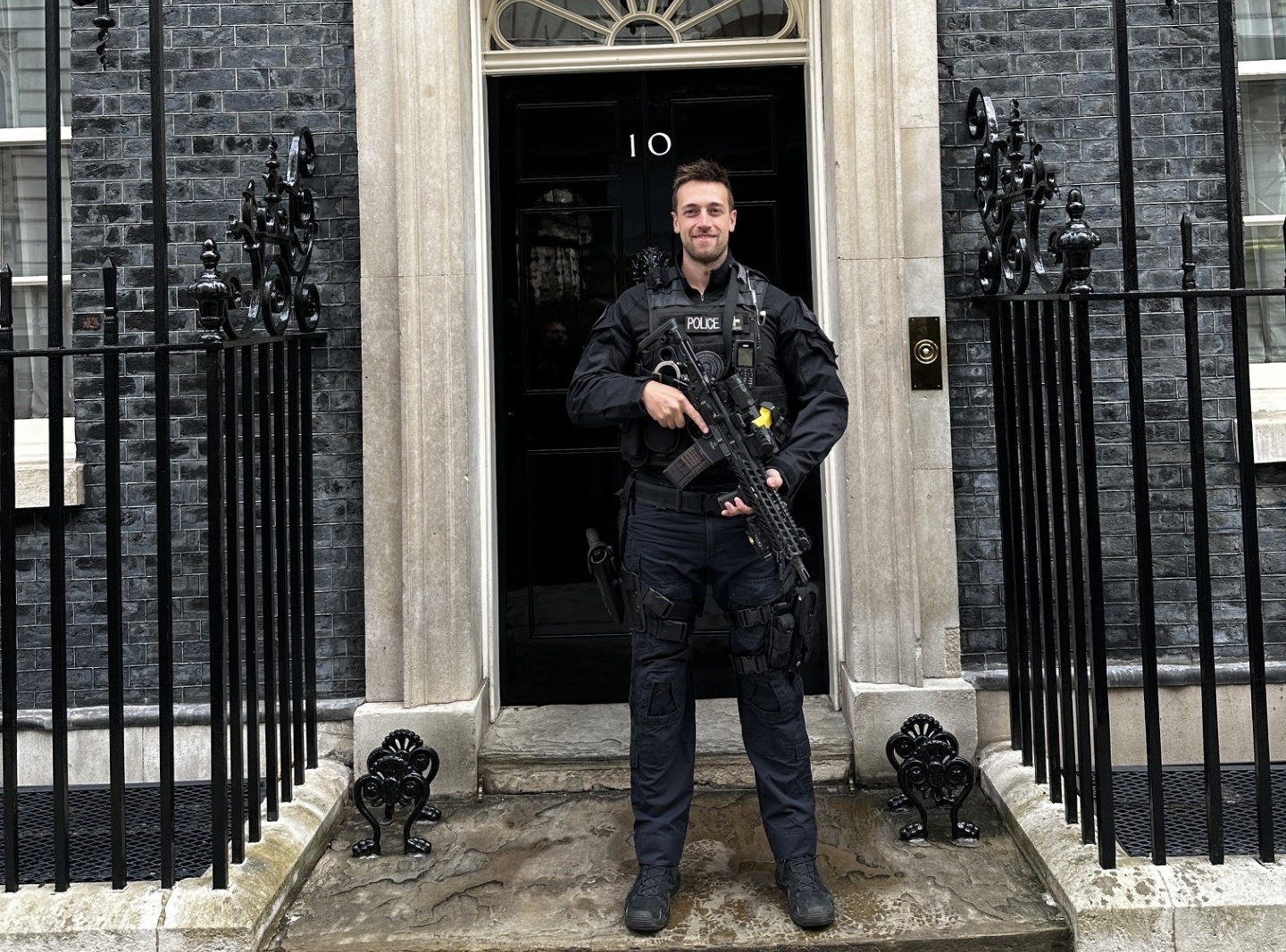
My name is Matt Efford. I am currently a serving Acting Police Sergeant on MO19.
I’ve been part of the command since 2019, and I can honestly say I’ve loved every minute of it. Serving alongside some incredible colleagues and doing a job I’m passionate about has given me a real sense of purpose. Away from work, I’m a husband and a father to two amazing young children who mean everything to me. I wanted to share my story because life can change in an instant. One moment everything feels normal, and the next, your world is turned upside down. It’s taught me never to take a single day, a single moment, or the people you love for granted.
My journey with brain cancer began on 18 December 2025. I was out Christmas shopping when, completely without warning, I collapsed. There were no signs, no symptoms, nothing to suggest anything was wrong. I blacked out entirely and required assistance from both the police and ambulance service. As fate would have it, an off-duty doctor happened to be nearby and witnessed what happened. He later explained that I had suffered a seizure. I had never experienced anything like that before. I’d always been healthy and had never faced any serious medical problems in my life. I was taken straight to hospital, where I underwent a CT scan followed by an MRI scan to try and find out what had caused me to collapse. A few days later, while still in hospital, consultants delivered the news that would change my life forever. They had found a brain tumour pressing on my brain tissue and believed it to be cancerous.
Nothing can prepare you for hearing those words. In a matter of moments, everything I thought I knew about my future suddenly became uncertain. The tumour was significant in size and was pressing against part of my brain, which had caused the seizure and loss of consciousness. On Christmas Eve, I met with a specialist neurosurgeon who confirmed that I had a cancerous brain tumour located in the front left side of my brain. Because of its size and position, surgery was the only option. The alternative was to do nothing and allow the tumour to take its course. The weeks leading up to surgery were filled with tests, blood work, hospital appointments and medication.
On 30 December, I underwent a further in-depth MRI scan that lasted more than two hours and involved contrast dye being injected at different stages. It wasn’t an experience I would ever want to repeat, but it was another step in understanding what I was facing. Throughout this time, I continued working in a desk-based role. My MO19 family looked after me exceptionally well, and I will always be grateful for the support they showed me. While I could no longer carry firearms or perform frontline duties, I accepted the reality of the situation and focused on taking things one day at a time.
The truth is, the diagnosis came as a complete shock. One day I was planning family life and looking ahead to the future, and the next I was trying to process the fact that I had brain cancer. There have been good days and bad days. Some days I’ve felt positive and determined. Other days have been far more difficult. But throughout it all, I’ve tried to keep moving forward and focus on what matters most: my family, my friends and making the most of every day. On 18 February 2026, I underwent brain surgery. Thankfully, the operation was successful and the consultant was able to remove what they believed to be 99 per cent of the tumour. The tumour was then sent away for analysis.
The results confirmed that I had an Astrocytoma, IDH Mutant, Grade 4 brain cancer. Hearing that diagnosis was incredibly difficult, but it also marked the beginning of the next stage of my fight. When I met with my oncologist, I asked the question every person in my position wants answered: “Will I ever be cured?” The response was blunt and honest. “It’s not a matter of if the tumour comes back, but when.” I was also told that the average life expectancy for someone in my position is currently between 12 and 18 months. Those are words that stay with you. As a husband and father, your mind immediately goes to the people you love. You think about the memories you still want to make, the milestones you want to see, and the time you desperately hope to have. On 30 March 2026, I began six weeks of intensive radiotherapy alongside daily chemotherapy treatment.
Since then, I have continued chemotherapy in cycles, consisting of 23 days off treatment followed by five days on treatment. This will continue over a 12-month period as part of the standard treatment plan. Despite everything, I still have goals. One of my biggest ambitions is to return to an ARV course at the start of 2027. I love what I do. Protecting the public from some of the most dangerous criminals in society is something that gives me immense pride. My aim is to become one of the first, if not the only, ARV officers in the country actively living with a brain tumour while remaining operational on the frontline. I refuse to let this disease define who I am. I have also been incredibly fortunate to receive unwavering support from the people around me. On 25 July 2026, MO19 honoured me with my own fundraising event, the Matt Efford Games. It was an emotional day and a reminder of just how lucky I am to be surrounded by such amazing people. Today, I am raising funds for immunotherapy treatment in Germany.
Sadly, it is not a cure. The goal is to give me more time, more opportunities to create memories with my wife and children, and more chances to enjoy the life that I love. Time has become the most precious thing in the world to me. By the time you read this, I will be preparing for my first appointment on 17 August 2026. My family and I are incredibly hopeful and excited about what lies ahead. We don’t know exactly what the future holds, but we do know that we will face it together. More than anything, this journey has taught me to cherish every moment, appreciate the people around you and never assume tomorrow is guaranteed. If sharing my story helps raise awareness, inspires someone facing their own battle, or simply reminds people to hold their loved ones a little closer, then it will have been worth it.