


'Still A Long Way To Go On Racist Abuse'
4 March 2026
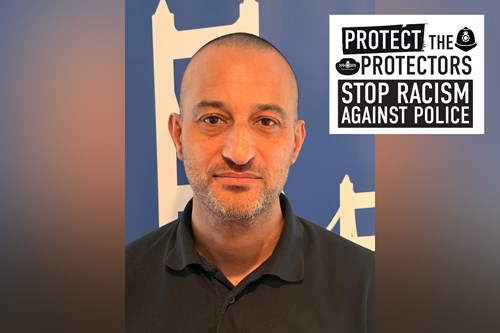
Humberside Police has come a long way in supporting officers who are victims of racial abuse, but there is still more to be done – beginning with understanding the scale of the problem – says the Federation’s Vice-Chair.
Chief Inspector Julian Hart is Humberside Police Federation’s Vice-Chair, Treasurer and PIP Lead. He joined the force in 2001, after a few years as a Special Constable, and has spoken out about his own experience of racial abuse as part of the Federation campaign: Protect The Protectors: Stop Racism Against Police.
Julian had a difficult childhood, and saw first-hand how police can help communities, spurring him on to join the force himself. He said: “Coming from a single parent family on a council estate in Hull, I often witnessed domestic abuse and violence. The police would often be called, and as a child I noticed that when the police arrived, the violence ended. That gave me inspiration to join and help others.
“So from an early age, that's what I wanted to do, I wanted to help people. When I looked at other people on the estates, they were getting arrested and going to prison, getting in trouble or dying young, and I just thought: ‘I want to get out of this and get on with my life.’
“No one in my family had ever joined the police. I just thought: ‘I want to make a difference in the area I live in, and do myself proud.’”
Julian, who is mixed race, said that when he first joined the police, racism was “prevalent” when he went out on the streets, but his colleagues didn’t always understand what he had to deal with.
He said: “The force has come a long way in terms of its diversity mix, but when I joined it was largely white. At the time, there were only around five or six officers from black and Asian backgrounds in the force and even fewer at higher ranks. So in terms of role models, there were very few that worked in Hull.
“I worked in the city centre, where you've got your night-time economy and your pub fights and all the rest of it. Racially abusing a police officer was almost… not guaranteed, but you could expect that you were going to get some racial undertones from suspects.
“There was one occasion where I arrested somebody for public order offences and he was so drunk that when I came in the next day he was still there. The sergeant at the time said to me: ‘Oh, this is yours from yesterday, you can deal with him’.
“I said: ‘But I'm a victim of his racial abuse against me’, and he said, ‘Well, you can still deal with him’. I challenged him on that, because how can it be right, as his victim, to deal with him as a suspect? But that was the kind of mentality within policing: alright, he's called you a few racial names, but you can still deal with him.
“That was one of my earliest experiences of thinking, well, if the supervisors don't get that, then how can we expect the workforce and the community to understand the impact it's having on officers from diverse backgrounds?”
In another early incident, Julian went with a white colleague to talk to a suspect at his house, and the suspect was so hostile that he came at him with a samurai sword. His white colleague stood in front of him to shield him.
Julian said: “I know some officers from a black or Asian background would say: ‘I'm my own person, I can deal with that’. But when you've been subject to it so many times… and sometimes officers aren't switched-on enough to think: ‘That's out of order, that's unacceptable, I'm going to step in and help my colleagues’.”
He said that the support from the force had got “massively” better in the intervening years, and that now when officers are racially abused a senior officer reaches out, as well as the Community Safety Unit.
But he said forces needed to get better at recording and recognising the scale of racism against officers. Humberside Police Federation is pushing for racial abuse incidents to be recorded separately, so that the data is readily available; currently, it is recorded under the umbrella of hate crime.
Julian said: “We can't, at the click of our fingers, understand the scale of the issue, because it is grouped under one umbrella. Only today, an officer in the Community Cohesion Unit told me: ‘We've got to read every crime report to understand if there's a police officer attached to it and whether that's racial or it's homophobic or it's religious’. So we still don't have the recording right.”
Ultimately, Julian said he would like to see extra legislation that protects police officers from racial attacks. He also wants to help colleagues and police leaders understand how officers feel when they’re being racially targeted, “as opposed to just being a statistic”.
He added: “To those who are suffering, please don't suffer in silence. Reach out to your line managers and your colleagues, because there is help available for you. And without your voices, we don't have the evidence to support the mandate for change.”


© Copyright 2020 Police Federation All rights reserved