


Policing White Paper: ‘listen to the voices of frontline officers’
27 January 2026
Luke was responding to the Government's publication of its new Policing White Paper, From local to national: a new model for policing.
The White Paper sets out a series of reforms which Home Secretary Shabana Mahmood has described as the largest in policing for 200 years.
Luke welcomed the acknowledgement that policing needed reform, but said the Federation and its members had to be involved in shaping the future.
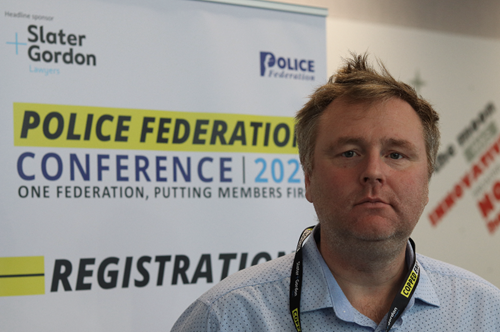
Luke said: “The launch of this White Paper is a recognition that policing is broken.
“And as a Federation, we are seeing that it is breaking too many of our members, who give everything to serve and protect the public.
“But any reform, particularly on such an unprecedented scale, must be done with the Federation and our members, and we must be listened to.”
Luke said proposals for a licence to practise needed careful consideration.
Warrant cards
Officers will be required to hold and renew a licence throughout their career. The Government said this was to ensure they developed new skills as criminal techniques evolve.
Luke said: “Aren’t our warrant cards already our licence to practise? The prisons are full, offenders are being released earlier and earlier, the courts have two year plus backlog - to me, it’s clear that police officers are clearly doing their bit. Will a licence really improve this?
“If we’re required to regularly renew our licence, it will require investment in training and support. Only this week I’ve learnt police forces are planning to cut the training for officers who do personal protection safety training, going from every year to every other year?
“Are we investing in training or not? Use of force is one of the most risky areas of our business - shouldn’t we be investing in this training?
“And will the licence apply to all ranks?
“This is sending such mixed messages to our members. Yet again, the devil will be in the details.
Culture
Luke said that, should a licence to practise be made mandatory, investment will be required to ensure gaps within the organisation are filled adequately and efficiently.
“Officers are routinely pulled away from training to fill gaps elsewhere, so it will need investment in other areas of policing to ensure those gaps are already filled.
“It will also require a change in culture that encourages professional development. Too often, our members are made to feel guilty about being away from their frontline duties to complete training.
“We need that time to be protected so they can complete training during their working hours.”
On proposals to merge forces, Luke said the current ‘postcode lottery’ in funding and support was ‘unfair and unsustainable’.
But he warned that fewer forces did not automatically mean better policing.
He said: “We need evidence that larger forces won’t weaken local accountability or lose connection with communities.
Investment
“And without proper, sustained investment in our people, equipment, estates, training, and remuneration, any large-scale reform will not deliver.”
Luke said that the creation of a National Police Service needed to be ‘absolutely clear’ about jurisdiction and accountability.
He said there was a case for national responsibility where threats are national, such as counter-terrorism.
But he added: “These have roots in local crime experienced directly by local communities, and will need input from local officers.
“A concern is that we might create gaps rather than fix them, which is why we need input from those on the frontline.”
Luke welcomed proposals on welfare, including mental health support.
He said: “Officers are exposed to high pressure and often traumatic situations, so proposals that support our members and their mental and emotional health are welcomed.
Suicide
“A good start would be to legally require policing to record every suicide and attempted suicide so we can understand the true scale of that particular issue.”
Luke continued: “Any reform must serve the public and our members.
“That means policing must be properly funded and resourced so we can meet demand and support officers and staff, and they need the political backing to allow them to do the job.”
He ended by urging those in power to ensure the Police Federation is a key stakeholder in any consultations around the proposed reform.
“I’m not convinced that the Government alone have the ability or knowledge to make the right changes for our members,” Luke said, adding: “It is more important than ever for our members to be heard, senior officers to have their say and the Federation to play a key role in any decision surrounding police reform moving forward.”
National chair Tiff Lynch added that PFEW has published ‘five tests that reform must pass if it is to deliver’.
She said: “Any proposals must be driven by evidence, not lowest cost, and must strengthen the front line. We are in favour of reform, but it must serve both the public and our members.”


© Copyright 2018 Police Federation All rights reserved