


Officers short-changed as Government rejects independent pay recommendation
20 July 2026
Hertfordshire Police Federation chair Luke Mitchell has criticised the Government's decision to ignore the advice of the independent pay body and award officers a 3.5 per cent rise.
The Government rejected the recommendation of a 3.9 per cent increase by the Police Remuneration Review Board (PRRB).
Luke said the decision would be ‘a bitter disappointment’ for officers.
He said: “The 3.5 per cent award does very little in terms of restoring police pay, which has fallen by 20 per cent in the past decade, particularly once inflation, higher pension contributions, and frozen tax thresholds are taken into account.
“It is especially disappointing that the Government has once again chosen to ignore the recommendation of the independent Police Remuneration Review Body.
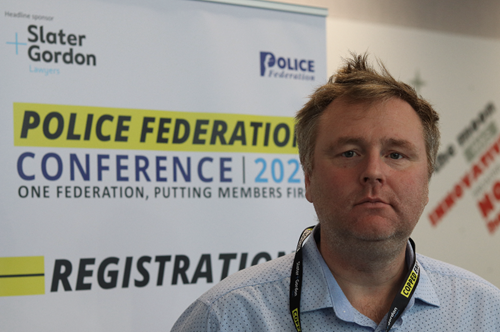
Hertfordshire Police Federation chair Luke Mitchell
“We can’t negotiate our pay, and have almost no way of challenging it, which means we rely on an independent process being respected.
"Every time ministers reject the PRRB's recommendations, it raises serious questions about the value of the review process.
“It's one of the reasons why the Police Federation of England and Wales has lost confidence in the current system."
The PRRB's report acknowledged the reality of modern policing, describing the routine use of cancelled rest days, short-notice duties and disrupted leave as ‘exploitative’.
Recruit and retain officers
It also said pay must be competitive to recruit and retain experienced officers.
Luke said those findings made the Government's decision even more difficult to understand.
He said: “Our members regularly have rest days cancelled, annual leave restricted and duties changed at short notice.
“They continue to go above and beyond despite the increasing demands placed upon them, yet this award fails to properly recognise that commitment.
“With policing already facing significant recruitment and retention challenges, this pay award will do nothing to stem the flow of experienced officers leaving the service or encourage new recruits to see policing as a long-term career.”
Acting Up Allowance
Luke welcomed the removal of qualifying hours for the Acting Up Allowance. This means that officers temporarily performing the duties of a higher rank will now receive the appropriate pay from their first day in the role.
He also highlighted changes to the South East Allowance, which will increase by 3.5 per cent this year.
However, he warned there remains uncertainty because future increases remain at the discretion of chief constables.
"The Acting Up Allowance changes are a positive step,” he said.
South East Allowance
“The increase in the South East Allowance is going to be an interesting one because it's still in the gift of chief constables to honour it, or to bring it up and down.
“So again, we're in their hands as to whether they're able to increase that.”
In its evidence to the PRRB, the Police Federation of England and Wales (PFEW) called for a minimum seven per cent pay award in each of the next three years to begin reversing years of real-terms pay erosion and stabilising the service.
PFEW national secretary John Partington said: “In going against the advice of its own expert pay review body, the Home Office has sent a clear message to police officers that it will ignore the evidence that shows police officers are long overdue a pay award that reflects their service and sacrifice.
Protect the public
“Police officers risk their lives to protect the public. The Home Office knows exactly the sacrifices the job demands, yet it has ignored independent advice.
“A pay award that barely beats inflation will drive more experienced officers out of policing, make recruitment harder and put the public at risk by weakening public protection.
“The Government found the money to give real pay rises to junior doctors and train drivers. But police pay declined by 22 per cent in real terms between 2010 and 2023, while the rest of the public sector saw its pay go up by 10 per cent.
Pay review process
“It’s clearer than ever before that the Government is controlling the pay review process.
“It handpicks the pay review body’s membership and tells them what they’re allowed to consider.
“It’s like a football match where one side selects the opponents’ players and referees the game.
“Even with all that in their favour, the Government has chosen to over-turn the result and fix the outcome.
“The time has come for a proper system of binding arbitration, along with collective pay bargaining, so police can be fairly paid.”
Chief Constable
Hertfordshire Police Chief Constable Andy Prophet said he was disappointed.
He said: “I am sure all the national staff associations are of one mind on this. Officers and staff deserve the very best levels of pay for the difficult and at times dangerous work you do.
“While the pay award is broadly in line with most other public sector awards, I am disappointed that the Home Office chose not to accept the independent pay bodies’ recommendations, which were that pay should be increased between 3.7 per cent and 3.9 per cent.
“I know police officers of all ranks will be disappointed that the pay award was not higher.
Independent pay review
“The purpose of independent pay review bodies is to make independent professional recommendations.
“Without the right to take industrial action, police officers should have confidence in the independent mechanisms used to fairly determine pay for public servants, irrespective of government pressures.”
He added: “The police staff pay award is subject to a separate negotiation yet to be announced but history suggests it is likely to mirror this.”
READ MORE: Attractive new savings rate with Serve and Protect.


© Copyright 2018 Police Federation All rights reserved