


‘Officers are being stretched to breaking point’: chair responds to policing crisis survey
20 March 2026
New findings that reveal a growing lack of public confidence in how police is delivered, particularly when it comes to everyday crime, reflects ‘the daily reality for our members’ says branch chair Luke Mitchell.
Luke is responding to Thursday’s UK Tonight: Is Policing Fit for Purpose? which featured survey data from Sky News and showed that while 53 per cent of respondents believe police investigate serious offences, just 14 per cent feel lower-level crimes are properly looked into. More than a third of victims - 35 per cent - are not reporting offences at all.
Reacting to the findings, Luke, chair of Hertfordshire Police Federation, said the figures come as no surprise.
“These results reflect what our members are experiencing every single day,” he said, adding: “But this should act as a wake-up call. When only 14 per cent of people think everyday crime is being investigated, it’s no wonder victims are walking away and not reporting offences.
“That’s not because officers don’t care - it’s because they simply don’t have the capacity.
Public expectations
“Our members are working incredibly hard to respond to demand, but when resources are stretched this thin, it becomes harder to meet the expectations the public quite rightly has.”
The data also shows a divide in public perception 62 per cent of people trust individual officers, but confidence drops to 48 per cent when it comes to senior leadership.
“The public still believes in frontline officers, and rightly so,” Luke said. “But confidence in the system is slipping. You cannot keep asking officers to do more with less and expect public trust to hold.”
The survey highlights widespread dissatisfaction, with 50 per cent unhappy with how police handle cases and 64 per cent of victims dissatisfied with outcomes. At the same time, 82 per cent of officers feel their role is misunderstood, and just 29 per cent feel appreciated by the public.
“Officers are proud of the job - they always will be,” Luke said. “But pride doesn’t fix burnout, and it doesn’t fix a system where demand constantly outstrips resources. Officers feel undervalued, and the public feels let down. That should concern everyone.”
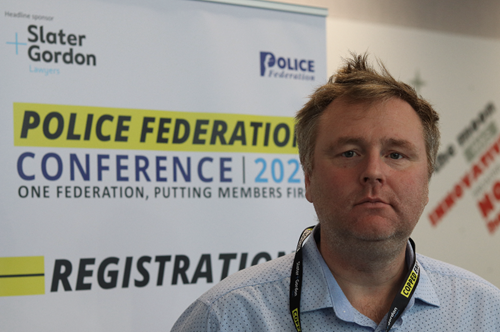
Branch chair Luke Mitchell
Central to the issue, Luke says, is a lack of funding and capacity. According to the findings, 93 per cent of officers cite underfunding as the biggest challenge, while 90 per cent say forces are understaffed.
“You can’t ignore those numbers,” he said. “Underfunding and understaffing are at the heart of this. Officers want to spend more time in their communities, tackling the issues people care about, but too often they’re pulled away by demand and bureaucracy.”
During the programme, presenter Sarah-Jane Mee spoke to the Policing Minister Sarah Jones, who highlighted planned reforms. Ms Jones spoke of plans to increase neighbourhood policing, reduce bureaucracy, and introduce clearer accountability measures, such as named local officers and improved response-time monitoring.
Reacting to Ms Jones’ comments, Luke said: “We’ve heard promises being made by the Government, but our members need to see that delivered, not debated.
Court delays
“You cannot rebuild neighbourhood policing on good intentions alone. It requires real, sustained investment.”
The programme also touched on wider pressures across the criminal justice system, including court delays and prison overcrowding - factors contributing to a perception that offenders face fewer consequences.
“Policing is just one part of the system,” Luke added. “When the wider system is under pressure, it impacts everything we do. Officers are left managing increasing demand while also dealing with those wider challenges.”
Despite the pressures, Luke was clear that officers remain committed to their role.
“Our members will always step up - that’s what they do,” he said, ending: “But they cannot keep carrying the weight of a system that is stretched to breaking point. If policing is going to be fit for purpose, then Government needs to step up too - and urgently.”
READ MORE: Officer opens up about 'invisible addiction' with gambling.


© Copyright 2018 Police Federation All rights reserved