


World Mental Health Day: ‘don’t wait for a breakdown to accept support’
10 October 2025
As we mark World Mental Health Day, Federation representative Sergeant Mark Essam is sharing his experience: one of resilience, recovery, and the importance of speaking out.
Mark joined the Force at just 20 years old. Now 39, he’s spent his entire career responding to some of the most traumatic incidents imaginable, including road traffic collisions, suicides, child deaths, and violent attacks.
For almost 10 years of repeated exposure to trauma, Mark admitted that despite being offered help, he never accepted it. He always thought he was ‘fine’.
“Nothing bothered me,” he said, adding: “Or so I thought. I just got on with it. Even though help was offered, I never accepted it. I didn’t think I needed it.”
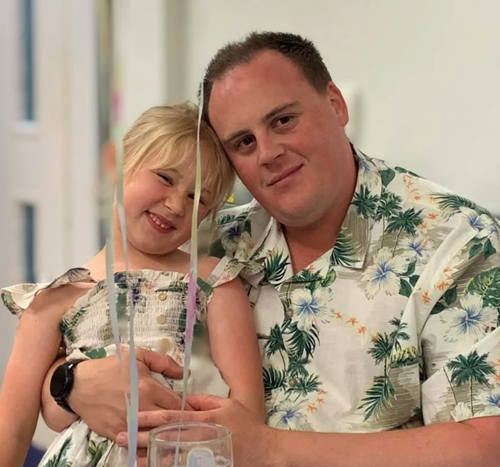
Sergeant Mark Essam with his daughter Violet
Everything changed in 2017. Mark’s wife was pregnant with their daughter when he attended a call that would alter his life forever, involving the sudden death of a young child.
“I ended up performing CPR on the child,” he said. “That’s when something in me changed overnight.”
In the days and weeks that followed, Mark’s mental health began to unravel.
“I had nightmares, hallucinations, hot flushes - even though it was winter,” he recalled. “I was angry all the time. My fuse was short. I’d eat constantly and then be sick. I didn’t want to walk, talk or even get out of bed. It was like the walls went up around me.”
Depression
His wife and colleagues quickly noticed the change.
Mark explained: “I used to be able to separate work and home life, but once we were expecting a baby, those two worlds blurred into one another.”
Eventually, his wife urged him to see a GP. The diagnosis was complex PTSD, depression, and anxiety.
“I was signed off work and referred to occupational health. I had counselling for three months, and my line manager was incredibly supportive. But at that time, I was still in denial. I didn’t fully accept what was happening,” said Mark, who talked about the toll mental health can take on a person.
“I put on four stone during that time. It’s a real struggle. Mentally, it can be torturous if you’re not coping.”
Complex PTSD, Mark later learned, isn’t about a single event but the cumulative impact of repeated trauma - the kind of trauma that frontline officers often experience.
PTSD
“People don’t always differentiate between PTSD and complex PTSD,” he said. “It’s about recognising what that looks like for each individual.”
After six months away, Mark returned to work. His daughter, Violet, had been born, and life seemed to be back on track. But several years later, now a sergeant, Mark found himself working on another harrowing case involving a child’s death. “It triggered everything again,” he admitted. “But this time, I recognised the warning signs.”
He was referred once more to occupational health - and this time, he began EMDR therapy (Eye Movement Desensitisation and Reprocessing), a treatment designed to help people process traumatic memories.
“EMDR changed my life,” Mark said. “It allowed me to talk about the job, reopen those feelings, and deal with them properly with the support of a counsellor. It was tough - I cried, I got angry, I got upset - but that was OK. Because I finally dealt with it.”
The result, he says, was transformative: “I feel great now. I’m the best dad I can be, the best husband, and the best police officer.”
Earlier this year, Mark took on a new role as a Federation representative, determined to use his experience to help others.
“There’s no denying that policing takes a toll, both mentally and physically,” he said. “I see officers breaking, just like I did. They convince themselves they’re fine because they don’t want to take time off, they don’t want to let their team down, or they fear the stigma. But it’s not a weakness. It’s a strength to admit you’re struggling.
Wellbeing
"I'm now working on myself - I've already managed to lose a stone in six weeks. Hopefully people can see that there is hope, and you can achieve your goals again
Mark believes the Force has more work to do in supporting officers’ wellbeing: “We’re bad at debriefing these days. We need to talk, we need to check in on each other. As managers, we have a duty to look after our teams.”
He’s also a passionate advocate for TRIM (Trauma Risk Management), the peer support system offered after traumatic incidents.
He said: “My message to members is: accept TRIM. Accept the support. Even half an hour with a TRIM officer after a traumatic incident could change everything."
Now, as both a sergeant and Federation rep, Mark wants to encourage every officer to look out for each other - and to make support non-negotiable.
“As line managers, we have a duty to not just encourage but insist that our people get support if they’ve attended a traumatic incident. Half an hour with a TRIM officer or six months off work - which would you rather?” he said.
Mark ended with an open invitation to members: “My door’s always open. Drop me an email, pick up the phone, or come and find me. It’s better to talk than to wait until you reach breaking point.
“Let’s make talking about mental health the norm, not the exception.”
READ MORE: Dedicated teams aims to maximise the impact of Knife Angel's anti-violence visit.


© Copyright 2018 Police Federation All rights reserved