


New tax measures will hit officers hard and add to retention crisis, says branch chair
4 December 2025
Hertfordshire Police Federation chair Luke Mitchell warned the retention crisis in policing will only get worse following the tax measures announced in the Budget.
The Government opted to freeze tax thresholds, the point at which workers start to pay tax, and also the point at which they go into a higher tax bands, for another three years up to 2031, dragging more people into higher bands over time.
New analysis from the Police Federation of England and Wales (PFEW) found that the measures will pull virtually the entire police workforce into the 40 per cent tax band within six years.
Luke said: “The changes in income tax and national insurance announced by the Government are, in effect, another pay cut for our members and another slap in the face for them.
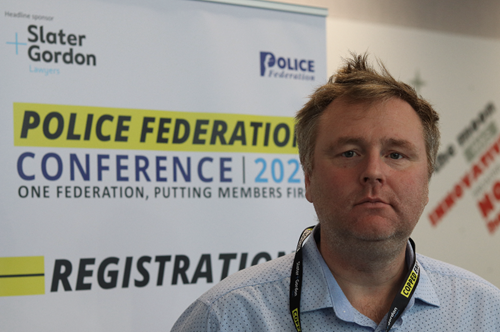
Branch chair Luke Mitchell
“They are working harder than ever, under more pressure and scrutiny than ever, but their take-home pay continues to be hit.
He said the tax changes only add to the existing financial strain officers face, pointing to the South East Allowance (SEA) as a clear example of pay failing to keep pace with reality. Luke has previously called for the allowance to rise to £5,000, arguing it has long fallen behind the soaring cost of living in Hertfordshire.
“Officers here face some of the highest living costs in the country, yet the SEA has barely moved in two decades,” he said. “It was designed to help with recruitment and retention, but at its current level, it simply doesn’t do that. Freezing tax thresholds on top of an outdated allowance is a double hit – and officers can’t absorb much more.”
Luke warned: “It will undoubtedly hit morale and make many of our members wonder if the pressures they face are worth it.
Retention crisis
“We already have a retention crisis in policing, and that will only get worse once these new measures come in, if not before.”
The Federation’s Copped Enough campaign was launched to highlight stagnant police pay, declining morale, and the recruitment and retention crisis.
A decade of below-inflation pay awards have meant that police pay is now worth 20 per cent less in purchasing power than it was in 2010.
Even though they are finding it harder and harder to make ends meet, officers – even those at the lowest ranks – now face having to pay 40 per cent income tax on some of their salary instead of 20 per cent.
Luke said: “It is criminal what has happened to police pay over the past 10 to 15 years.
“Too many members are already struggling to pay their bills or put food on the table, and some are even turning to food banks.
“It can’t go on.
Pay award
“We need a fair pay award for the people who keep us all safe before we see an exodus from policing.”
Key findings from the Federation’s new analysis:
-
Almost every officer will be a higher-rate taxpayer by 2030–31
By 2030–31, under current Government policy, it is projected that 97.8 per cent of full-time federated officers will pay higher-rate tax - meaning almost every full-time officer in England and Wales will be pushed above the £50,270 threshold. -
Constables are being hit hardest
Constables are the engine room of policing. Yet for the first time in modern history, higher-rate tax will apply to the average constable (99.8 per cent of full-time constables by 2030-31). -
‘Pay progression’ no longer means taking home more pay
Under the Government’s policy, any constable currently serving in 2025 and progressing normally through the pay scale will automatically fall into the higher-rate band by 2031. -
Taxation is wiping out the value of pay awards
Average officer pay includes overtime, allowances and specialist payments - because that is what they are taxed on. With the Government’s freeze locked in until 2031, fiscal drag, not real earnings growth, is driving officers into higher tax brackets. The result: every pay award is worth less the moment it is announced.
Police Federation CEO Mukund Krishna said: “This new analysis is stark. Freezing tax thresholds until 2031 means almost every police officer in England and Wales will be paying higher-rate tax within six years.
“Not because they’re earning more, but because the Government has designed a system that quietly drags them into higher taxation every year. It is a stealth tax in its purest form.
Exodus
“Higher-rate tax used to apply to senior ranks but now it’s bearing down on the average constable.
Officers tell us the same thing everywhere we go: they are working harder, under more pressure, yet taking home less.
“This is a system producing an exodus of experience as officers resign in record numbers.
“The impact on community safety will be stark unless the Government acts with urgency to restore police pay and deliver a truly independent and fair mechanism with collective bargaining and binding arbitration at its heart.
“Our Copped Enough campaign stands for fairness, respect and proper support for policing. This Budget takes us further in the wrong direction.”
READ MORE: Officer suicide discussion 'incredibly impactful' says equality lead.


© Copyright 2018 Police Federation All rights reserved