


Officer tells his story to back the STEP campaign
11 September 2025
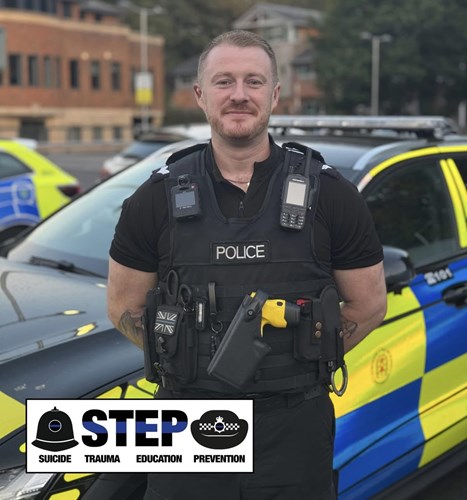
A Hampshire Police officer whose mental health was severely affected by the demands and traumas of policing – and twice came close to suicide - has talked about his experience and why he supports the STEP campaign.
PC Arnie Wilson has given his backing to the ongoing push to reduce the number of police officers and staff who take their own lives, by raising awareness of the trauma they face and encouraging them to seek help if they’re struggling.
Arnie was speaking out to mark World Suicide Prevention Day 2025 – and as it emerged this week that at least 100 police officers and staff have taken their own lives in three years in a growing mental health crisis.
The STEP - Suicide Trauma Education Prevention - campaign was started by Spencer Wragg, Chair of Hampshire Police Federation, and has now been taken up around the country.
Arnie started his policing career as a PCSO in Hampshire Constabulary, before transferring to Thames Valley Police in 2018 to be a response officer.
He recalled: “I’ve always been determined to become a police officer. When I first became a PC, it was going great and I loved the job. But about two years in, I started to struggle with carrying everyone’s trauma with me. I’m quite a compassionate guy, which made me good in terms of giving people a good service. But I would go home and think, ‘Oh my God, I hope they're OK’.
“Then I got called to a scene where there was a dead body, and even though I'd been to worse incidents before, something seemed to click inside me. I just became empty. Seeing that much death and hurt and pain, I didn't know how to deal with it, I didn't know what tools were available. I just thought it was part of the job.
“I’m usually quite a lively, energetic guy, but I started going into myself, crying randomly. And then it just spiralled. My mood got lower, I was losing weight.
“It got to the point where I took a day off because I thought, ‘I can’t face work today’, and that day off ended up being just under three months off work.”
During their careers, each police officer is likely to encounter between 400 to 600 traumatic events. Most citizens will experience between three or four in their lifetime.
Arnie continued: “I thought, ‘If I can't help other people and I can't do my job, then what actually is the point of me?’. I've always thought that policing was what I was meant to do and that I should be able to fix everything, which I know now is completely unrealistic. I wasn’t thinking rationally.”
At the worst points of his depression, Arnie twice tried to end his life, but was saved both times by his partner at the time, now his wife.
He said: “I took myself to the top of a bridge with the full intention of ending it. But because I shared locations on my phone with my partner, she found me and physically grabbed me – it was the fear in her voice that brought me back.
“My wife saved me twice. I said in my wedding vows that I wouldn't be here today if I hadn't met her. That’s a really sobering thought, because I could have prematurely ended my life and not experienced all of the positive things that I've experienced since.”
His partner took time off work to look after him, and encouraged him to have cognitive behavioural therapy (CBT).
Arnie found CBT transformative, recalling: “In my counselling sessions, I was made to feel secure. It was a safe setting, and I didn't feel like anyone was judging me. I realised that what I was feeling wasn’t stupid – it was the chemicals in my brain having a hold on me.
“Yes, it was daunting getting better, but do I want to die? No, I wanted how I'm feeling to die and there's ways of doing that without hurting the people I love.”
Arnie slowly found his way back to health, and a year later transferred back to Hampshire Constabulary, where he is now enjoying his role and receiving good welfare support.
He said: “I'm now an area car driver in response, and have been an acting sergeant. My colleagues trust me, and I've received awards for my work. I've got married, I've done all of this incredible stuff and I never would have experienced any of that had I not had the support from my wife and my counsellor. I just think to myself that there is always tomorrow. I’ve even got it tattooed on my arm: ‘This too shall pass’.”
Arnie recently had what he describes as a “wobble” in his mental health and took a couple of weeks off work. He said: “I now fiercely safeguard my mental health, and my Sergeant and Inspector have also been absolutely incredible in their support.”
It was after returning to work that Arnie made the decision to be open and honest about his mental health struggles, despite the continued stigma. He added: “I would encourage others to be open up too, so we can continue to make mental health less of a taboo subject.”
Arnie continued: “We give everything to the public and leave next to nothing for ourselves. That also applies to line managers, who can become so entwined in resourcing and pressure from up above that they have no idea what morale is like on the ground.
“When I’m sergeant-ing, welfare comes first. If someone is struggling with something, I'm going to do everything I can to help them.
“People see the police as a hardy job, but it doesn't mean that you have to change who you are. You can be tough and strong, but you can also be open and compassionate.”
Between 2011 and 2022, there were 242 suicides of current police officers and PCSOs in England and Wales.
Between 2021 and 2024 an estimated 80 former and current police officers took their own lives.
Arnie’s message to other officers who were struggling was: “You feel like you're on your own, but you're not – there are people who will listen to you. Please talk to someone, be honest and say, ‘Look, I am genuinely struggling here. Please help’.”
In the meantime, Arnie has just qualified to be a mental health peer supporter, so that he can be one of the people that officers can talk to.
It is important for officers who are struggling to know they are not alone, and that there are people there to help.
This includes, for immediacy, the Mental Health Support line from Oscar Kilo 0300 131 2789.
Officers can also access the support offered by charities and organisations including Flint House, Police Treatment Centres, The Ben Fund, Oscar Kilo, and the ‘Stay Alive’ APP from


© Copyright 2019 Police Federation All rights reserved