

Thirty years in the police. Where on earth do you even begin?
2 April 2026
Detective Constable Vicky Knight reflects on three decades in policing as she kicks off her retirement.
I joined bright-eyed and freshly pressed, landing on the streets of Salford convinced I was about to become the next great crime-fighter. My very first night shift involved a helicopter overhead, the dog unit deployed, and me legging it down back alleys after a burglary suspect - with absolutely no earthly idea what I would do if I actually found them. Arrest technique? Words of advice? A stern look? Thankfully, I never had to find out.
Back then, policing was analogue in every sense. The radios crackled and could be hijacked by local comedians breaking into the channel - they had all the reliability of a kitchen toaster. We had no sat-nav, no mobile phones, and certainly no ‘quick Google’. You either knew your patch, or you didn’t - and woe betide you if you took a wrong turn and had to admit it over the air.
Within my first couple of years, I’d shut down a precinct because someone handed me an unexploded First World War shell (as you do), responded to every complaint imaginable, and perfected the art of looking confident while having absolutely no idea what was going to happen next.
Then there was the infamous ‘thief on a roof’ incident. A dramatic call. Urgent response. Local youths pointing helpfully toward a building. Two officers - me included - charging heroically forward, straight into a suspiciously leaf-covered pond and freezing water. The only criminal act that day was the assault on our dignity. The youths, I’m pleased to report, survived the laughter.
Uniform
And let’s not forget the uniform. I remember being issued a wooden-handled baton, handcuffs, and - yes - a police-issue handbag. A handbag. Which I used, proudly. Practicality over pride. It carried everything: notebook, pens, odds and ends, and, crucially, lip gloss. Operational readiness comes in many forms.
After cutting my teeth on foot patrol, I achieved the holy grail of early service - the driving course. Back then, you had to prove you were steady enough before being trusted with a set of keys. It was a badge of honour. Today, I suspect the car has more computing power than the entire station has.
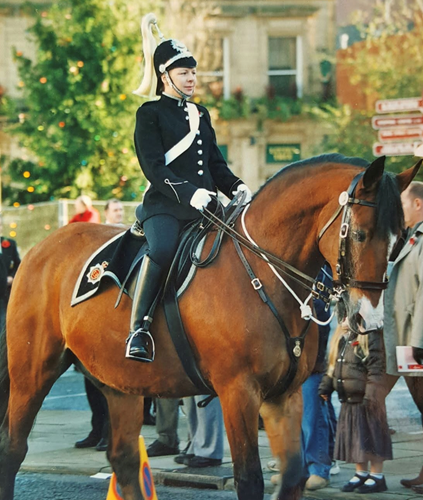
Then came the mounted unit - every horse-mad girl’s dream realised. Five glorious years atop several tonnes of calm authority. Football matches, protests, riots, city centre events - all handled from the saddle. There is nothing quite like being the visible face of policing while sitting on an animal that could, if it chose, ignore absolutely all your instructions. Thankfully, they rarely did. The public loved the horses, but complaints came in abundance about the mess they left in their wake.
Later, I moved into public protection - managing sex offenders, online investigations, the darker corners of humanity. A far cry from pond-diving and radio pranksters. By then, the internet had arrived, and crime had discovered Wi-Fi. Gone were the days of handwritten files and physically walking prisoners across the road to court with three photocopied bundles under your arm.
Paperwork
Transferring to North Wales was like entering a different universe. One of my first CID jobs involved a marauding goat. Not a riot. Not a burglary. A goat. My colleague calmly retrieved a bucket from the boot, shook it, and called, ‘come on, goat!’ The animal obediently followed him back into its field. ‘Bet they never teach that in Manchester’, he said. No. No, they do not.
Over time, the paperwork has multiplied, pay has shrunk in real terms, and everything has become digital, measurable, and reviewed. We used to review the weekend jobs over a brew on a Monday morning. Now, everything is scanned, uploaded, and scrutinised before you’ve had your first sip.
But despite the technological revolution, the essence hasn’t changed. The young officers still arrive bright-faced and determined to make a difference - just as I did, clutching my baton and handbag.
Thirty years on, I’ve chased burglars, ridden horses through riots, fallen into ponds, negotiated with goats, argued cases to custody sergeants built like ex-miners, and survived the evolution from handwritten custody records to digital case files.
And through it all, I’ve learned one thing: no matter how much policing changes, it will always find new and inventive ways to keep you humble.
READ MORE: In our latest Federation magazine - OUT NOW and available online.
Hot topics
Quick links to information on the national Police Federation website: