

Matchday policing evolving to match Wrexham’s rise through the leagues
10 November 2026
The rapid rise of Wrexham AFC has brought new challenges for the officers responsible for matchday policing.
Sergeant Sarah Hughes-Jones, a Neighbourhood Policing Sergeant covering Wrexham city centre, has been at the heart of that evolving operation.
Alongside her neighbourhood policing responsibilities, Sarah is one of North Wales Police's operational football officers, working closely with Wrexham AFC, stewards, security staff and supporters at both home and away fixtures.
She is also one of the Force’s four female football officers and works alongside Sergeant Kelly Lewis, who was runner-up for the operational football officer of the year at last year’s UK Football Policing Unit awards.
Kelly developed and implemented the community policing approach used at Wrexham AFC home matches. The model has received national recognition and is being considered by other forces due to its success.
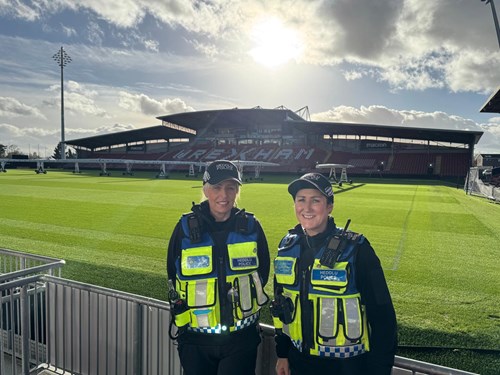
Sergeant Sarah Hughes-Jones and Sergeant Kelly Lewis
Sarah said the scale and complexity of matchday policing has changed dramatically as the club has progressed from non-league football to the Championship.
12,000 spectators expected at each match
She said: "Five years ago, you were lucky if you could get 3,000 people at a game. We've seen Wrexham evolve from Wrexham Town to Wrexham City, and the football club, along with owners Rob McElhenney and Ryan Reynolds, have given it an international platform.
“It's allowed businesses and individuals to thrive. It's brought investment, hope and a fantastic sense of community. We now have around 12,000 people attending matches every other weekend. We are playing different teams with different dynamics, and we've had to adapt to meet those challenges."
The club's remarkable progress has seen Wrexham face opposition that supporters could scarcely have imagined a few years ago, including clubs with larger and potentially higher-risk fanbases.
Sarah added: "Never in their wildest dreams would Wrexham supporters have thought five years ago that they would be playing against Premier League teams. However, with that comes a heightened level of risk and a different set of policing considerations associated with some of those clubs and their supporters. It's changed massively."
At home matches, Operational Football Officers work alongside the Dedicated Football Officer, Wrexham City Neighbourhood Policing Team and Public Order Officers.
Their role involves monitoring known individuals, responding to emerging incidents, providing reassurance and safeguarding, and supporting Operation Virtue, North Wales Police's Violence Against Women and Girls initiative. This work is carried out whilst ensuring that those attending and supporting football enjoy the best possible experience when visiting Wrexham.
New challenges during away matches
Away fixtures bring a different experience, requiring officers to work alongside other police forces and in unfamiliar environments. Sarah says this has provided valuable development opportunities for football officers across the Force.
"For many years, Wrexham played against the same teams, so you became familiar with the supporters, locations and policing style," she explained.
"You'd often have the same officers attending and the same groups of supporters, so you could draw on previous experience. Over the last few years, it's been different forces, different supporters and different locations. The dynamic has changed, and everyone has had to evolve with it, which has been a great experience."
A key part of that evolution has been building strong relationships with supporters and ensuring matchday policing is not solely focused on enforcement.
Bridging gaps with the community
Sarah says the Wrexham City Neighbourhood Policing Team has worked tirelessly to build trust and confidence within the football community, with officers becoming a familiar, regular and approachable presence around fixtures.
That approach has helped foster an element of self-policing amongst supporters, with fans often challenging inappropriate behaviour within their own groups. Where necessary, however, robust enforcement and the use of Football Banning Orders provide an effective deterrent.
Sarah believes it is equally important not to lose sight of the overwhelming majority of supporters who simply want to enjoy the game.
We must remember that the vast majority of people come to enjoy football, have a good day out, and leave Wrexham with a positive impression of both the club and the city."
Sarah always wanted to become a police officer, despite spending around 12 years working in banking after leaving school.
Following redundancy, she joined North Wales Police as a Police Community Support Officer before becoming a Police Constable and later progressing to Sergeant.
She believes her previous career provided valuable skills in communication, problem-solving and working with people, all of which have transferred into policing.
Those skills have also proved invaluable in her role as a North Wales Police Federation Representative.
Sarah has been a Federation representative for around four years after being encouraged to consider the role whilst dealing with an unrelated matter.
Initially unsure whether she could balance the additional responsibility, she ultimately viewed it as an opportunity to develop new skills whilst supporting her colleagues.
Supporting colleagues as a Fed rep
She continued: "We all joined this job because we want to help people. I saw it as a development opportunity, a chance to learn different things and to support and protect officers as best I could within my remit."
Much of her Federation work has focused on equality, wellbeing and welfare, particularly around menopause and neurodiversity.
She has helped raise awareness of menopause across the Force, reducing stigma and creating positive working environments. This has included supporting conversations around flexible working, reasonable adjustments, workplace passports, uniform considerations and practical measures tailored to individual needs.
Menopause-related absences are now recorded separately rather than simply being categorised as sickness, helping the Force better understand its impact on the workforce.
Sarah has also supported neurodiversity initiatives, including the development of an ADHD support group and encouraging officers to feel comfortable discussing workplace adjustments.
Most recently, she attended a specialist course alongside Federation colleague Gemma Poulton, exploring how best to support officers who find themselves as victims within misconduct or conduct proceedings.
The course brought together representatives from across the country, including colleagues from the Metropolitan Police and Greater Manchester Police.
"It was really valuable to hear about the challenges, themes and experiences being faced elsewhere. Bringing that knowledge back helps you become a better voice for officers and provide reassurance and support when they need it most."
READ MORE: Police cadet programme 'helping young people reach their potential'
Hot topics
Quick links to information on the national Police Federation website: