


Member encourages colleagues to take PSA test after 'shock' prostate cancer diagnosis
28 November 2025
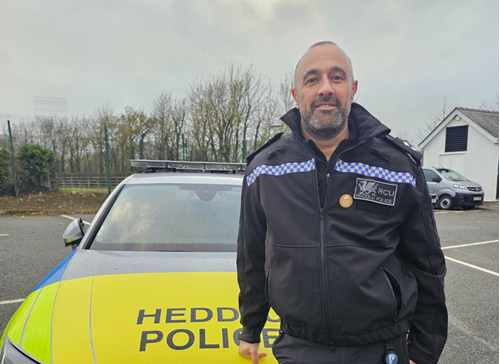
A North Wales Police Federation member has told how he was diagnosed with prostate cancer after an in-Force test – despite having no signs or symptoms.
Now Inspector Jason Diamond is encouraging male colleagues to take the opportunity of the regular PSA testing events that are held by North Wales Police and the Graham Fulford Trust.
Jason said: “I’m sharing my story to encourage anyone who is in the age range to take a PSA test. Why would you not?
“A simple blood test saved my life. The next life it saves could be yours.”
PSA testing
Jason attended a PSA testing session in Bangor on 7 November 2024.
Just two days later, he received an email advising him that his PSA level had been raised.
“It was a bit of a shock,” he said. “I had absolutely no symptoms. Had the Force not offered the test, I’d never have gone to my GP. There was nothing that would have made me think I needed one.”
He contacted his GP on 11 November – his 53rd birthday – and was seen the same morning. A subsequent MRI scan in December was inconclusive, leading to a biopsy early in the new year.
“You’re suddenly in much more of a medical setting,” he said. “You’ve got consultants dealing with you. It’s the moment it all becomes very real.”
The call to return to hospital confirmed what he had already begun preparing himself for, that some of the samples were positive for prostate cancer.
Jason said: “It wasn’t a shock in truth, because with being called into hospital, I realised and had got my head round what I was going to be told.
“I didn’t know the procedures that were going to follow, so I was a bit matter of fact in saying ‘right, what do I do next?’
Prostate cancer
Jason’s Gleason score – a measurement of the aggressiveness of prostate cancer – indicated a potentially aggressive form.
Following discussions with specialists, he opted for robotic prostatectomy surgery, to remove the prostate, at University College Hospital London in June 2025.
Before the operation, he underwent a bone scan, a moment he described as the most anxious of the entire process.
“I was aware of Chris Hoy’s story and people where it had spread to their bones,” said Jason. “That was the only time I felt genuinely nervous.”
The bone scan was clear, and surgery went ahead on 12 June.
“I was surprised how well I coped,” Jason said. “There’s discomfort and side effects, of course, but they’re minor compared to the alternative. The surgeons always remind you they’re saving your life.”
Around four weeks later, he received the news he had hoped for, that the cancer had been fully contained within the prostate.
Saved my life
Jason, who is back at work full-time, thanked the Force and the Graham Fulford Trust.
"The test saved my life," he said. "They told me the cancer could have spread within two years. Today I feel no different to the day I had the PSA test.”
Jason, who was speaking during 'Movember' (Men's Health Month), added: “To anyone who is in the age range, or at higher risk, if you’re offered the opportunity, take the test. It’s one simple blood sample.
“If everything is fine, great. But if it isn’t, catching it early gives you every chance. “
What is a PSA test?
A PSA test checks the level of prostate-specific antigen (PSA) in a person’s blood. High levels may be a sign of a prostate condition.
Testing may be recommended if a person is experiencing the following symptoms:
- Peeing more than usual (or having a sudden urge to pee or get up often in the night to pee)
- Blood in pee
- Problems getting or keeping an erection
How to get a PSA test?
While routine PSA testing is not offered on the NHS, a person may be offered a PSA test if their doctor thinks they have symptoms that could be prostate cancer.
Men aged 50 or over can ask their GP for a PSA test, even if they do not have symptoms.
Anyone aged 50 or over with a prostate can ask for a PSA test.
Officers can attend any PSA testing event arranged by North Wales Police. For information relating to dates and locations, please contact Jayne Humphreys by emailing Jayne.Humphreys@northwales.police.uk
READ MORE: Branch welcomes change in compensation guidance for injured officers.
Hot topics
Quick links to information on the national Police Federation website: