


‘Changes need to work for officers’: Branch secretary reacts to ‘huge’ police reform plans
28 January 2026
A White Paper titled ‘From local to national: a new model for policing’ has been published, with Home Secretary Shabana Mahmood describing it as the largest shake-up of the profession in 200 years.
The document has set out aims to strengthen neighbourhood policing, boost national capability against serious and complex crime, save money and streamline resources.
While approving of these ambitions in principle, Lesley stopped short of endorsing the White Paper as a whole due to concerns around key proposals such as a licence to practice for officers and the merging of police forces.
She said: “As a Federation, we recognise that policing needs to change. We have been one of the voices calling for reform, because we are aware our members are overworked and under pressure to breaking point.
Reform
“We know the current model needs improvement but change requires significant investment in policing as a whole.
“How long will our workforce and the public have to endure further instability whilst these changes are brought in and at what cost? Policing already has difficulty with attracting officers and once they join, retention is the next problem. Increasing demands both operationally and academically, without the essential investment we need leads to officers leaving in numbers we have never seen before.
“These plans currently only serve to exacerbate that.
“Officers deserve better, staff deserve better, and the public deserves better, so major changes are in everyone’s best interests. However, it is important to look at whether these plans would really leave our members and the public better off.
“I would question whether the Government have put enough stock into the views and considerations of police officers themselves in the creation of this White Paper, despite the fact that the need for overall change has been recognised.
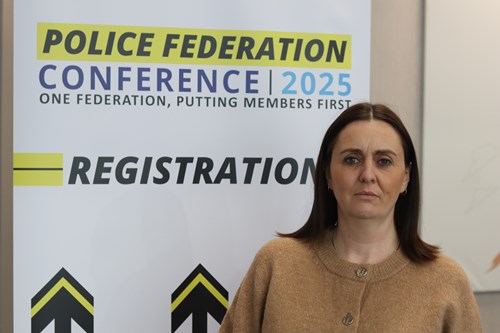
Branch secretary Lesley Williams
“A change of geographical boundaries does not mean more police officers to patrol the force areas. We will have the same number of officers policing a significantly increased area of demand.”
Expressing her views on the idea of officer licensing, she continued: “A licence to practise is not going to ensure officers have the skills and capability to do the job – that comes from recruitment, vetting and initial police training.
“We have lost the training schools we had years ago, where those skills were instilled in all officers. Now it’s young, new in-service officers tutoring new recruits without the experience or knowledge themselves and being expected to step up as supervisors when they have little experience themselves.
“There’s also the question of who will be expected for pay for the licence. Our members are already under enough financial pressure from inadequate pay, with some officers on the breadline, using food banks, and unable to even pay into pension schemes.
Licence
“Neither is it clear if the licence will be different for each rank, which could cause complications for training and progression.”
Lesley then voiced her concerns around the proposed merging of forces, with departments becoming centralised, such as serious and complex crimes, forensics and counterterrorism.
“I can appreciate the fact that policing may benefit from national responsibility and directives when it comes to complex, cross-border crime, but I’m not sure if that will outweigh the risks of such a drastic overhaul in force make-up,” she said.
Lesley praised some of the targets outlined in the White Paper, including the expanded rollout of a Mental Health Crisis Line for officers and staff, as well as annual psychological risk screenings for front-facing and high-risk roles.
She continued: “In an ideal world, I can of course get behind faster response times to serious incidents in both cities and rural areas – as mentioned in the White Paper – but there still needs to be consideration to how officers are empowered and supported to deliver that.
White Paper
“Are the Government really prepared to do what it takes to look after our frontline officers and the demands and expectations they face?
“For me, any reform needs to be reflective of what life is like on the frontline for officers – the only way they do that is by listening to those people and their thoughts.”
The Police Federation of England and Wales (PFEW) has also shared its view that, despite giving cause for optimism in some respects, the White Paper in its entirety still has plenty to prove, with five recommended tests police reform must meet.
Echoing these sentiments, Lesley added: “It’s a Federation responsibility to think about what any set of changes – big or small – could mean for our members. These proposals could clearly be huge for our profession, so we must do everything in our power to ensure they work for officers, as well as working for everyone else.”
All members are encouraged to engage with the Federation and share their views on the White Paper.
READ MORE: Our key takeaways from the White Paper.


