


#SimplifyDG6 campaign 'steadily achieving its aims' branch secretary tells conference
20 November 2025
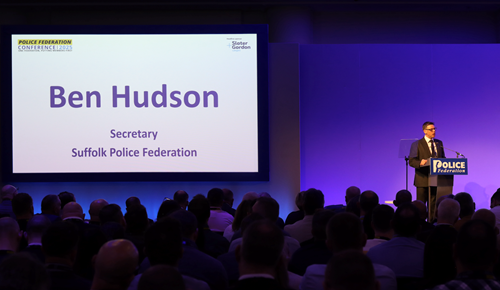
Suffolk Police Federation secretary Ben Hudson used this year’s Federation conference to highlight the significant progress of the #SimplifyDG6 campaign.
Ben, who is also chair of the Police Federation National Detectives’ Forum, told conference the campaign was ‘steadily achieving our aims’.
He was updating delegates during day two of the conference at the NEC in Birmingham.
The #SimplifyDG6 campaign was launched in 2022 to tackle the excessive bureaucracy of disclosure requirements.
It followed the Attorney General’s Annual Review of Disclosure, which acknowledged shortcomings that left officers spending ‘at least four hours more on each case due to the redaction requirements’.
Ben said: “We have listened to members’ concerns, acted on what they told us, and helped bring about reform that will make a huge difference to their working lives.”
Progress
A partnership approach has been crucial to that progress, he said, thanking Surrey Chief Constable Tim De Mayer, the National Police Chiefs’ Council (NPCC) disclosure lead, and Stephen Parkinson, director of public prosecutions, for their involvement.
Ben said: “The very fact that Tim and Stephen are both here, I believe, typifies the partnership approach that has enabled us to help drive change that will not just benefit police officers and police staff but will also bring time savings for forces, freeing up officers and staff to deliver more effective policing services for the communities we serve.”
The Police Federation of England and Wales (PFEW) campaign:
-
Urged the Government to make amendments to the data protection laws to simplify the redaction obligations of police officers and staff when seeking charging decisions from the CPS to free up thousands of policing hours every year
-
Called on the NPCC, the College of Policing, and the Crown Prosecution Service to jointly work with the Federation to ensure all its members receive nationally agreed face-to-face training on disclosure procedures.
The campaign has made progress, Ben told conference.
Redaction
The NPCC issued amendments to the Joint Principles for Redaction, which were developed by the Crown Prosecution Service (CPS) and the NPCC disclosure portfolio, set out their joint position on how to approach data protection responsibilities.
They provided clearer, legally robust guidance on redaction and disproportionality. Updated FAQs now take a more pragmatic approach to data minimisation, giving officers clearer direction on issues such as occupations, dates of birth and vehicle registration numbers.
The Federation reinforced the new guidance with a national toolkit distributed to all 43 branches, ensuring members understood how to apply the revised principles.
Political backing has also grown. MPs have expressed support for a proposed ‘data bubble’ between the police and the CPS. The proposal has been echoed in an independent review by barrister Jonathan Fisher KC.

The review further recommended national learning standards for new officers, cross-agency disclosure learning standards, and clearer accreditation pathways for disclosure officers.
Ben said that proportionate file-building trials were underway in Cheshire, Merseyside and Kent.
In Cheshire, compliance reached 97.2% within two months, saving 5,000 policing hours.
One sergeant described the trial as ‘an absolute dream, Ben said.
In Kent, nearly 400 files were submitted in just five weeks, with 37 per cent savings in file-building time. It’s hoped this will reach 40% to 45% in the months ahead.
Simplify DG6
Improved victim engagement and shorter bail periods are already being reported, Ben told conference.
Sussex and Surrey are next in line for the rollout, Ben said.
He said: “Our campaign has not only garnered support but has helped deliver meaningful and significant change.”
Ben ended: “We will continue to push for the change we need to see. Perhaps what we really need is a total rewrite of DG6 – could DG7 be the answer?”
READ MORE: Forces urged to formally record all police suicides.











© Copyright 2019 Police Federation All rights reserved