


National secretary highlights pay, recruitment, and wellbeing concerns at conference
18 November 2025
The Police Federation of England and Wales (PFEW) annual conference highlighted a profession under pressure. Following the chair’s address, national secretary John Partington delivered a forceful statement on the need for urgent reform in policing pay, conditions, recruitment, and officer welfare, warning that the challenges facing officers cannot be ignored.
Addressing colleagues, John emphasised that policing now requires a louder, unified voice to advocate for fairness, transparency, and the long-overdue recognition of the responsibilities carried by officers across England and Wales.
John explained that over the past year, the Federation has made significant progress toward greater transparency and member engagement. For the first time, members received full sight of the final pay offer before a decision was made - a change the Federation described as 'how it should be: a two-way conversation, not a closed-door process.'
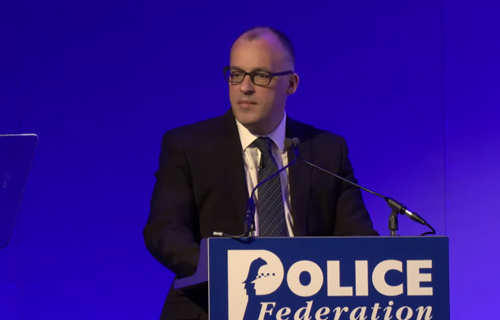
National secretary John Partington addresses day one of the PFEW conference.
He said that evidence and advocacy presented by the Federation contributed to a 4.2 per cent pay rise, increases to allowances, improved overnight and hardship payments, and a commitment to address critical issues such as compensation for extra hours worked, shift disturbance, and detective burden.
Later in his address, John highlighted the urgent need for standardised psychological testing for all police recruits across England and Wales. He stressed that policing is one of the most regulated professions in the UK, yet recruitment standards vary widely. Psychological testing, he argued, should be 'a safeguard, not an optional extra', ensuring candidates possess the temperament, values, emotional readiness, and resilience required for modern policing.
Emotional strength
He added: “We know what happens when the wrong people get through the door. This cannot happen again. The public deserves officers who are not only capable but also have the integrity and emotional strength to uphold the core principles of the job. This job isn’t for everyone. It demands resilience, empathy and strength. These qualities can’t be assumed, they must be tested.”
Delegates heard stark warnings about worsening financial pressures on frontline officers, including rising housing, energy, food, and fuel costs that have far outpaced police pay, leaving many officers struggling to meet basic household expenses. John highlighted the inequity of equal-percentage pay awards, which disproportionately impact lower-paid officers.
Wage inequity
He said: “A superintendent and a constable face the same inflation, but not the same reality. Percentage-only rises deepen inequality. Without correction, policing will become unaffordable for the very people who make it work.”
John confirmed that the next pay submission will argue for targeted increases that recognise the unique pressures facing frontline ranks. He also criticised the current pay review body as “not fit for policing,” citing political constraints and lack of independence. To ensure fairness, the Federation is calling for a move toward collective bargaining and binding arbitration.
An Early Day Motion has been submitted in Parliament, with cross-party support, and the Federation is exploring legal avenues and international labour law implications.
Underpaid, undervalued, overloaded
John concluded: “Keep underpaying, undervaluing, and overloading officers, and more will leave permanently. This government is pushing policing toward a crisis unless urgent action is taken. Policing demands deep knowledge, emotional strength, and the courage to hold the line when everything else gives way. Officers deserve pay, conditions, and pensions that reflect that burden. We are not asking for special treatment - we are asking for fairness.”
Day one also included discussions on supporting officers’ families, and a keynote speech and Q&A with PFEW chief executive Mukund Krishna.
Presentations for the Outstanding Contribution to Women in Policing Award, and the Detective of the Year, were also given.
Tomorrow’s sessions start at 9.20am and includes a keynote speech from Tiff.
Panel discussion
There will be a panel discussion on policing’s suicide crisis, an update on the #SimplifyDG6 campaign, and a panel Q&A.
Awards for Investigation of the Year and Response Officer of the Year will be presented as well.
You can re-watch today’s sessions and tune in live tomorrow via the PFEW YouTube channel.
READ MORE: Conference day one: Copped Enough campaign making an impact.











© Copyright 2019 Police Federation All rights reserved