


Men’s Health Month: ‘listen to your body and your loved ones’
26 June 2025
A cancer survivor is encouraging Suffolk Police colleagues to listen to their bodies and to their loved ones when it comes to their health.
Inspector Matt Paisley, vice-chair of Suffolk Police Federation, says he owes his life to his wife Siân, who encouraged him to see his doctor about a persistent cough.
Matt was diagnosed with testicular cancer that had spread to his lungs.
Now he is using his experience this Men’s Health Month to encourage officers to get themselves checked out if they - or their loved ones - are concerned about their health.
Matt, who is also the branch professional development lead, said: “My advice is to listen to your body and listen to those closest to you.
Cough
“They’re the ones who are going to pick up on something.
“Maybe it’s a change in how you’re acting, how you’re talking, how you’re behaving – and then really act on it.
“I knew I had this cough. It was on the back of the Covid lockdown, and I was really conscious of it around people.
“I’d say to people I haven’t got Covid, I’ve been tested, that it’s just a cough.
“So I knew something was up, but I just didn’t allow myself to sit and think about it.
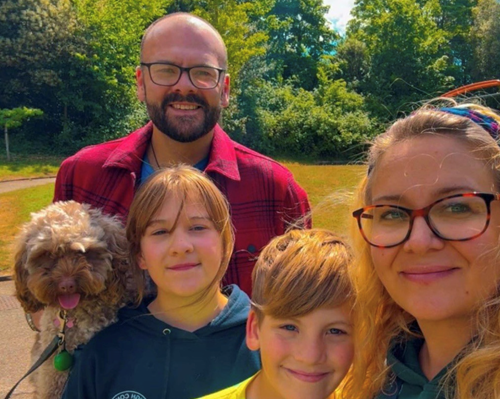
Inspector Matt Paisley (holding dog Penny), his wife Siân (right),
his daughter Isla and son Noah.
“My wife also knew something was up, but I wasn’t listening to her. Eventually I did, but if I hadn't gone to the doctors in April 2021, I wouldn’t be here now, because that thing was just going and growing and spreading.
“I’ve also been hit with another lesson. About a year after I stopped treatment, my mum, who’d had breast cancer some years before, was complaining of stomach problems, and I was telling her to go and get checked out.
“She didn’t, and by the time she did, it was too late. She was diagnosed with terminal cancer at the end of October and died on 11 November.
“So, listen to your body and listen to your loved ones.”
Testicular cancer
Matt was diagnosed with stage three testicular cancer in May 2021. He’d had the cough for around six months when he went to the doctor.
“At that time, I was fit and healthy,” said the 45-year-old. “I was running loads, and I felt mentally sharp. It wasn’t impacting my work.”
The father of two was sent by his GP for a chest X-ray, which revealed a shadow. He was then sent for a CT scan of his upper body.
“It came back that I had a few tumours on both lungs,” he said. “They knew at that point it was cancer, but they didn’t know where it was from, albeit they suspected testicular.
Lungs
“I was told that any cancer that’s spread to the lungs is difficult to cure, and until we find out the source, we’re looking at a worst-case scenario.
“But I then had a CT scan that picked it up. I had cancer of the testicle, but there were no lumps.
“It was engulfed. It spread over the whole testicle and it was smooth, so you couldn't feel anything.
“It was only when they did the CT scan that they picked up on it.”
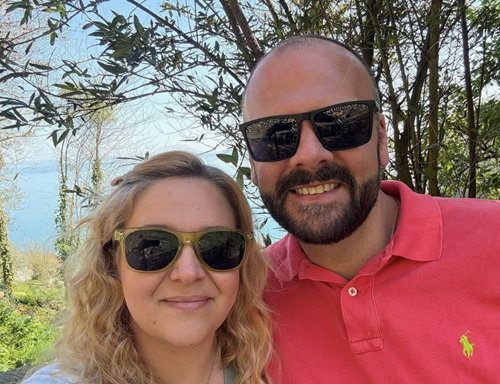
Inspector Matt Paisley with his wife Siân.
Matt was diagnosed on 5 May, he had an operation to remove the testicle at the end of May and, in June, he was put on a condensed course of chemotherapy to give him the best chance of curing the cancer.
His treatment cycle finished in the September but it was not until November 2022 that he was told he was cancer-free.
“The chemo continues working for up to two years after treatment,” he explained.
“The biggest tumour I had in one of my lungs was originally four centimetres by three centimetres.
“Although it was smaller, I still had that after treatment, and so the drugs continued to work on it, and then the following November I was told I was cancer free.”
Matt spoke about the physical and psychological impact of his illness and treatment.
Imposter syndrome
“I’ve always been conscious of my own impostor syndrome and a lack of self-belief, a lack of self-confidence,” he said.
“Bizarrely, sitting in the treatment room, having chemo for nine hours a day, put it in perspective.
“It made me realise I am who I am and I’ve got control over certain aspects. In that respect, it's made me more confident.”
He added: “I had seven months off work. I came back for a couple of hours a day. I built up over a year to full hours and I thought, naively, that I was Superman and could put it all behind me and move forward.
Working day
“But what I didn't factor in was what’s called post-chemo fatigue, which some people have permanently, some people have for six months or a year.
“It’s something I still fight with today. It kind of drains your body.
“It’s made me more conscious of what I eat, drink and quality of sleep, because there are some days that I might struggle to get through the full working day.
“There are some days I get through the working day fine then in the evenings, I’m just shattered.”
Matt said that the illness has also given him some perspective.
“There is a sense of a rebalance of what’s important in life,” he said.
Counselling service
“At the beginning, I really struggled. Macmillan provided a counselling service, and I remember saying to the counsellor that I was completely lost, that I didn’t know who I was anymore
“You go through this whole wave of emotions, thinking about the ‘what-ifs’ and the ‘maybes’. What does life look like 10 years down the line?
“It taught me to rein all that in and focus on the now, because you’ve got no control over what happens tomorrow and next year and the next decade.
“I love policing. I'm really invested in my career. But at the same time, I nearly lost everything, and I’m thankful for every day.
“I often say to people that cancer saved my life, which is an odd thing to say, but it put perspective around what’s important.”
READ MORE: Suffolk entrants to national police dog trials take a lot from the event.











© Copyright 2019 Police Federation All rights reserved