



“You’re joking, not another one?”
10 August 2026
Just days after the latest amendments to police conduct regulations came into force, the Home Office announced yet another review of police misconduct procedures. At what point do continual reforms stop improving the system and start undermining it?
West Midlands Police Federation conduct and performance lead Dave Hadley has written a blog setting out his views after the Home Office announced at the end of last month that it had launched an ‘end-to-end’ review into the police accountability system.
The review will be chaired by Dame Lynne Owens, a former Deputy Commissioner of the Metropolitan Police and a former Director General of the National Crime Agency, and Jason Beer KC who are expected to report back within six months.
It will look at how police officers are held to account, identify barriers that can delay outcomes, and consider how the system can be made faster, fairer and more effective.
Dave writes:
The disciplinary framework has become increasingly complex and prescriptive over the past decade, often without a clear evidential basis for the changes. To fully understand the issue, it’s worth considering a timeline of regulatory changes since 2012.
October 2012
New conduct regulations replaced those in place since 2008.
March 2015
Amendments were made. Among other things, the power to chair hearings was taken away from chief officers and given to Legally Qualified Chairs (LQCs) and for the first time misconduct hearings would be conducted in public.
In answer to public concern about officers avoiding accountability by retiring before any disciplinary hearing could take place, a prohibition was placed on them retiring while subject to gross misconduct proceedings.
December 2017
Within two years, the cost of compelling people to remain in service, when they would otherwise resign or retire was costing forces significant sums. The solution was to amend the regulations to allow officers to retire while facing gross misconduct proceedings. The safeguard enacted by the amendment was the creation of the ‘barred’ and ‘advisory’ lists.
February 2020
A complete replacement of the regs in an attempt to move away from a culture of blame towards a culture of learning. It introduced provisions such as the reflective practice review process (RPRP) and attempted to provide a threshold for Appropriate Authorities to apply when considering misconduct.
The 2020 regs were amended shortly after enactment to address procedural issues relating to the Independent Office for Police Conduct (IOPC) that hadn’t originally been included.
May 2024
After significant political pressure from the National Police Chiefs’ Council (NPCC), the power to chair conduct hearings was returned to chief officers.
May 2025
Regulations were amended to create a presumption of dismissal for officers following a finding of gross misconduct.
As an aside, May 2025 also saw the enactment of vetting regulations, which although not technically ‘conduct’ related, do offer professional standards departments (PSDs) an alternative to dealing with potential misconduct via a route which is much faster, and arguably less fair, than an Accelerated Misconduct Hearing.
June 2026
Regulations were further amended to clarify provisions relating to the test to be applied in use of force cases, following the W80 Supreme Court case and the Police Accountability Rapid Review, commissioned following concerns raised after the prosecution and subsequent acquittal of a Metropolitan Police firearms officer in the shooting of Chris Kaba.
July 2026
Another amendment introduced revised provisions relating to suspension from duty, effectively restricting the decision-making in relation to suspension.
More recent reforms have been reactive responses to high-profile events rather than the product of long-term evaluation. Those high-profile incidents which directly instigated reform of the disciplinary regulation include the death of Sarah Everard at the hands of serving Metropolitan Police officer Wayne Couzens; the sexual offending of serving Met officer David Carrick; the issues at Charing Cross Police Station which became notorious following the findings of Operation Hotton, which uncovered officers exchanging racist, misogynistic, homophobic and discriminatory messages and raised serious concerns about culture and supervision within the Met.
These incidents prompted the 2023 independent review into the standards of behaviour and internal culture of the Metropolitan Police Service by Baroness Casey. The problems were real, there was a loss of public confidence in light of these scandals, but the reforms which were enacted as solutions were not perhaps the best answer to them.
We should be concerned about politically driven reforms which are not predicated upon a sound evidential basis: ‘Hard cases make bad law’.
Yet that is what has happened in relation to police disciplinary procedure reform. Prior to the amendments in 2024, the NPCC was able to convince the Home Office that the system of LQCs was to blame for the loss of public confidence in police disciplinary systems.[1] The problem with this was assertion was that the available evidence did not support the conclusion that LQCs were responsible for a decline in dismissals. The Home Office’s own review of the LQC chaired provisions [Home Office Review: The process of police officer dismissals, September 2023] concluded:
“the statistical evidence does not support an argument of systemic leniency” it went on to say that “the review has been provided anonymised case studies of where the LQC has decided an officer ought to be dismissed, but has been ‘out-voted’ by the other panel members and so a Final Written Warning was issued.”
The review also found:
“the evidence does not support an overall decline in either the volume or proportion of dismissals. Between the years ending 31 March 2017 and 31 March 2019, there has been a decline in dismissals at accelerated hearings, chaired by Chief Constables, where an increased proportion of officers had been found to have committed gross misconduct, but issued with written warning rather than being dismissed.”
The Police Federation described this as a “retrograde step,” warning that it “could see a return to the “dark days” of “kangaroo courts”. Even the IOPC had expressed public disapproval of the proposal. Yet, despite this, the Home Office amended the regulations, returning the power to chair hearings back to chief officers for the first time since 2012, regardless.
The rate of change
The frequency of changes being made to the police disciplinary regulatory framework has increased since 2020. You only have to consider the raft of changes and amendments in this decade to those in the previous decade to illustrate that point.
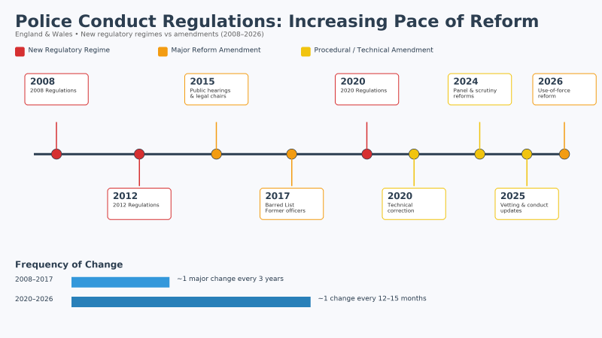
The constant change means that amendments aren’t afforded an appropriate amount of time to ‘bed-in’ before changes are applied; the ink isn’t even dry on the latest amendments and yet here we are with yet another review; cue the “You’re joking, not another one” memes.
Each successive amendment has further constrained the discretion available to decision-makers when determining a proportionate outcome. The cumulative effect of this is a system that is moving towards a prescribed process rather than one capable of responding to the particular facts and circumstances of an individual case.
A misconduct system should command public confidence, but it should also retain the flexibility to distinguish between differing levels of culpability and harm. Where discretion is progressively removed, there is a danger that outcomes become driven less by the specific circumstances of a case and more by a desire to demonstrate a hard line on discipline.
There is a tendency to focus almost exclusively on dismissal statistics as a measure of systemic success; dismissal figures start to look like a measurable performance target, and most serving officers will recognise the distortive effect that targets have on policing activities, for good or ill. In focussing on dismissals as an outcome, proportionality is the casualty.
Dismissal carries significant consequences, not only for the individual concerned but also for the wider service and the public purse. The immediate loss of employment, the long-term impact on pension provision, restrictions on future employment opportunities and the reputational effects of a gross misconduct finding are all profound.
There is also increasing recognition of the strain that misconduct investigations can place on officers’ wellbeing and mental health. For example, suicide rates among serving police officers is a national concern. The percentage of those suicides where a live PSD investigation was present has been estimated by the Police Federation of England and Wales (PFEW) to be around 70 per cent.[2] While the existence of an investigation cannot be assumed to be the cause of such outcomes, the data nevertheless demonstrates the significant pressures that disciplinary proceedings may place on some officers.
The financial implications should also not be overlooked. Considerable public resources are invested in recruiting, vetting, training and developing police officers. Where dismissal is the appropriate outcome, those costs are an unavoidable consequence. However, where a proportionate alternative is available, the loss of that investment is a legitimate consideration.
It is reasonable to ask whether the public would invariably expect dismissal in every case where gross misconduct has been found. It is far from clear that an informed and fair-minded member of the public would always favour dismissal once they understood the circumstances of an individual case, the impact on the officer concerned and the wider costs involved. This is especially true at a time when in the West Midlands we can’t afford to empty the bins regularly.
Nobody would sensibly argue that misconduct should go unaddressed. Rather, it is suggested that the system as a whole should retain sufficient flexibility to deal with cases quickly, effectively and proportionately. A re-calibration is required: written warnings, final written warnings, misconduct meetings and RPRP all exist for a reason. Properly understood and consistently applied, they provide an ability to address many forms of misconduct without resorting to a career-ending sanction in circumstances where a lesser outcome may better serve the interests of justice, proportionality and the public.
The 2020 reforms promised to deliver a sensible, proportionate approach to misconduct procedures; a cultural change from one which focusses on blame, to one which encourages transparency with learning at its heart. West Midlands Police Federation calls for these aims to be finally realised for the benefit of officers, forces and the public.
The reforms to the conduct system in 2020 were supposed to move policing from blame to learning. Six years later, we have moved from learning back to punishment. Before we rewrite the rules again, we should ask whether constant reform is solving the problem or becoming part of it.
Causes of delay
My view is that the following are the main causes of delay in conduct cases:
The chronic under-funding of the police service, which impacts up PSD like every other department. There are not enough staff to investigate matters thoroughly and in good time; further there is insufficient capacity to ensure hearings are held in a timely manner.
The lack of any meaningful timescales applied to PSD investigations. PFEW has long campaigned to introduce a 12-month time limit on investigations.[3] The only concession to this by the Home Office has been the inclusion of a Regulation 19 ‘timeliness report’ which, to be frank, is a relatively meaningless provision; it doesn’t enforce timeliness and does not provide any consequences which arise from investigative tardiness.
The long delays in the courts which leave misconduct matters unable to be addressed because of the convention against considering matters which are sub judice. We are currently listing cases into the summer of 2029. That’s three years during which a suspended officer must be retained on full pay, waiting for their opportunity to clear their name, before misconduct processes can be held.
The risk averse nature of forces which are primarily, and perhaps understandably, concerned with avoiding reputational damage in light of high-profile scandals in policing. If evidence of a loss of proportionality needs illustrating, it can be found in the falling number of misconduct meetings, with a rise in the use of misconduct hearings and accelerated hearings. There is a lack of operational understanding and use of reflective practice among supervisors; it is still erroneously viewed as a sanction by many officers. If employed properly many instances of misconduct might never occur, either because they would be dealt with expeditiously by local supervision, or future instances of misconduct would be far less likely to occur following the reflection and learning that was had in more minor incidents.
The 2024 enacted ‘presumption of dismissal’. Supporters of the reforms would argue that the public expects officers found guilty of gross misconduct to be dismissed and that previous systems were insufficiently robust. However, it is argued to be counter-productive by making it less likely that an officer will admit their wrong-doing, leading to a backlog log of contested hearings.
Chair backs conduct lead
Jess Davies, chair of West Midlands Police Federation, supports the views of the branch conduct lead.
She says: “For many years now there has been little to no opportunities for learning and reflection, rather a default position to dismiss. This is not in the spirit of what the modern conduct regulations were designed for in my opinion.
“While there are, of course, matters that are only suitable for dismissal, there are also numerous cases where there is an opportunity for an officer to reflect, learn and become a better officer for it. This links into the recent release of the Government’s police workforce statistics which show there has in the last four years been a concerning and significant rise in officer dismissals.”
[1] https://www.independent.co.uk/news/uk/home-office-police-officers-government-chris-philp-metropolitan-police-b2402249.html
[2] https://polfed.org/news/latest-news/2026/the-silent-crisis-killing-police-officers-more-than-100-suicides-since-2022/
[3] https://polfed.org/campaigns/time-limits/