


Driving force behind change in roads policing legislation retires
8 May 2026
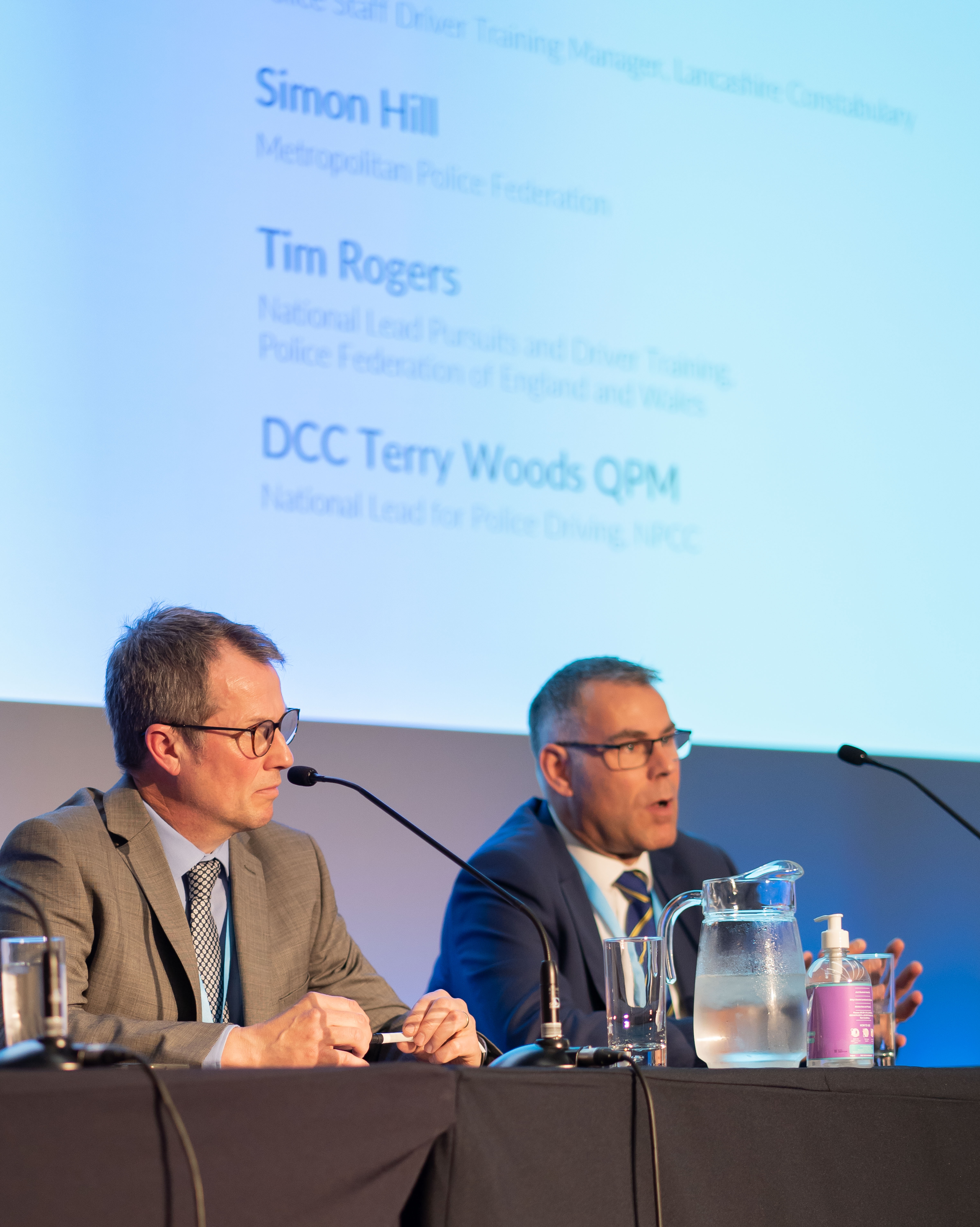
Tim regularly spoke at conferences as he led the Federation campaign for a change in the law.
Twenty-four years after first becoming a workplace representative, West Midlands Police Federation secretary Tim Rogers has retired from the Force.
Tim has enjoyed a wide and varied career that saw him recognised for his work as a senior investigating officer in collision investigation and awarded the King’s Police Medal (KPM), the highest honour in policing for distinguished service.
While honoured to receive the KPM, he remains most proud of delivering lasting change to roads policing legislation, knowing it has made a real and enduring difference to officers across England and Wales.
Tim, who served West Midlands Police for 31 years, led a successful eight-year campaign to change the law so that police drivers are no longer judged by civilian standards when responding to emergencies. It was a campaign marked by persistence, setbacks and resistance at senior levels, but one he continued to drive forward, knowing the consequences officers faced under the existing legal framework.
Thanks to his efforts, the legislative change was delivered through the Police, Crime, Sentencing and Courts Act 2022, ensuring that officers’ driving is assessed against that of a “competent and trained police driver”, rather than a “careful and competent member of the public”. It is widely recognised as a generational shift in the protection of officers carrying out high-risk duties.
Protected
Reflecting on the award at the time, Tim said: “I knew how much this change mattered to officers on the ground. They deserved to be protected in law for doing what they were trained and expected to do. That was what I fought for. This recognition is appreciated, but the change itself was the reward.”
Looking back on his service, Tim says he has no regrets, describing a career where each role he performed felt like the best job at the time.
After a short spell in media sales with the Trinity Mirror Group, he joined West Midlands Police in May 1995 and was posted to Coventry, where he quickly developed a passion for roads policing that would remain throughout his service.
Four years in, he became a traffic officer and remained in roads policing for the rest of his operational career. He later led a local traffic division, developing a proactive motorcycle capability that delivered visible impact in reducing volume crime and improving road safety. Combining traffic enforcement with a highly mobile bike team proved both operationally effective and personally rewarding.
Alongside this, he was involved in a number of significant operational and strategic projects across Coventry. These included planning and delivering traffic management for the opening of the Ricoh Arena, implementing a city-wide ANPR scheme, and leading the re-engineering of Coventry’s PrimeLines bus corridor following a series of fatal collisions.
Partnerships
“These were practical interventions where the aim was simple,” he explains. “Reduce harm, manage risk and make the network safer while still allowing policing to function effectively. They required strong partnerships.”
In 2002 Tim was promoted to sergeant, shortly after becoming a Federation representative, and in 2005 he became a senior investigating officer working on road death investigations.
He later helped establish the Force’s Road Death Investigation Unit, professionalising the approach to fatal and serious collisions and aligning it with national standards.
“There can be an assumption that when someone dies on the road, someone must be to blame,” Tim says. “Families quite understandably want answers. The role was about finding the truth for them and supporting them through the worst moments of their lives.
“I worked with a dedicated team whose commitment to getting those answers was second to none. The pressures they worked under were significant, often comparable to major crime investigations, but without the same level of resource.”
Despite his experience, he says the emotional weight of the role never diminished: “People often ask if it gets easier. It doesn’t. If anything, it gets harder. As you get older, you understand more about what those families have lost. That stays with you.”
Central role
Alongside his operational work, Tim remained committed to his role as a workplace Federation representative, something he considers central to the organisation.
“This is perhaps the most important part of what we do in the Federation,” he says. “Workplace reps are the lifeblood of the organisation. They see what is happening day to day, they hear directly from officers and staff, and they give people a voice. That should always be where the focus sits.”
That work provided the platform for him to take on the Federation’s roads policing portfolio nationally, bringing officers together through conferences, sharing best practice and influencing both policy and legislation.
The campaign to change the law on police driving required sustained engagement with the National Police Chiefs’ Council, Government departments, legal experts and politicians.
“I worked with a number of policing ministers during that time. Some were supportive, others less so. There were points where it would have been easier to stop, but the issue was too important. Officers were being judged against a standard that did not reflect their training or the reality of what they were asked to do,” he explains.
Standards
Following the legislative change, Tim remained closely involved in ensuring that training standards and post-incident assessment processes were properly embedded across policing: “The legislation only works if it is applied properly. There is still a tendency in some areas for people to drift from the standard or misunderstand it. That requires firm competent leadership, otherwise you risk putting officers back in the same position the law was designed to fix.”
From a Federation perspective, he is also proud of the work carried out within the West Midlands branch.
“At times we have been criticised for asking difficult questions of the national Federation, but we have always done so in the best interests of the membership. It is essential that governance is robust and that finances are handled properly. Every pound of members’ money matters,” Tim says.
Tim served as deputy branch secretary from 2015 and branch secretary from January 2022, during which time the branch developed new ways of working, including the introduction of a regional solicitor model to better support members across the region.
However, he acknowledges that recent years have brought significant challenges.
Reform
“There have been clear fault lines at a national level. Issues around governance, transparency and accountability should have been addressed earlier and more openly. In some cases, concerns that were raised were not well received at the time but have since been borne out,” Tim explains.
“There has been a repeated narrative of reform, but reform has to be real. The organisation has been given a number of opportunities to reset. Confidence will only be rebuilt through consistent action, not statements.”
Despite this, he remains clear about the importance of the Federation: “The Federation matters. When it works well, it is a vital support for officers. The challenge now is ensuring it consistently delivers on that purpose.”
As he reflects on his career, Tim also acknowledges those who supported his work along the way, particularly senior leaders who recognised the value of his national work and gave him the time and space to deliver it.
“Chief officers – including former Chief Constables David Thompson and Craig Guildford - I worked under understood the importance of what we were trying to achieve and supported it. Without that, much of the work would not have been possible.”
Respect
He also praises Terry Woods, the NPCC lead for roads policing who saw the need for a change in the law. Tim describes him for his accessibility and pragmatism but also for his reputation as a ‘doer’ who listens intently to the people around him who know the business.
Tim also singles out Steve Barry, the Sussex ACC who, like Terry, has had a focus on roads policing. But finally, closer to home, Tim speaks of his respect for former ‘gaffer’ – Superintendent Paul Keasey – who he said recognised the high level of pressure and emotion in the accident investigation role.
On retirement, Tim has taken up a role within the Force working in employee relations.
It is a natural progression of the work he has been doing throughout his career.
“A lot of what I have done, whether in operational policing or the Federation, has been about people,” he says. “Supporting them properly, making sure they are treated fairly, and ensuring they are able to do their jobs effectively.
Privilege
“In employee relations, that continues. It is about keeping people at work where possible, resolving issues early, and making sure the organisation gets value from its people while also doing the right thing by them. When you get that balance right, it benefits everyone.”
Despite the move, he admits stepping away from Federation work will not be easy.
“I am going to miss it. Representing colleagues, challenging where needed, and working with a strong branch has been a privilege. But I am not too far away.”