



Volunteer ambassadors aim to drive professional standards
21 May 2025
A team of volunteers are aiming to ‘bridge the gap’ between the professional standards department (PSD) and other areas of the Force.
Sergeant Scott Davies is part of a network of more than 100 standards ambassadors across the organisation.
They want to drive professional standards of behaviour in their areas, promote a better understanding of the work of PSD and provide feedback on officers’ concerns.
Scott said: “The ambassadors are a conduit between professional standards, standards managers and departments across the Force.
“It’s bridging a gap that might be there between PSD and officers and staff. PSD is trying to promote a better understanding of professional standards.
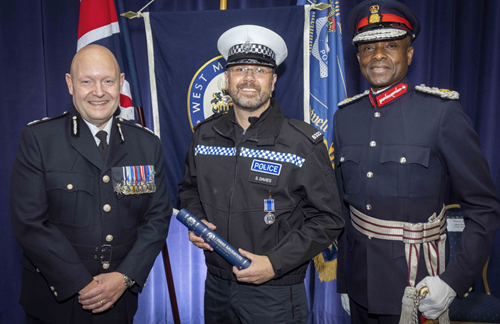
Sergeant Scott Davies receiving his Long Service and Good Conduct award
from West Midlands Police Chief Constable Craig Guildford and
Lord Lieutenant Derrick Anderson CBE.
“The ambassador role is part of that, to bridge that gap and take the messages back from PSD that ultimately that it is there to uphold the standards and make sure we police ethically and do the right thing at the right times.”
The ambassador roles have been running for around 18 months.
They offer advice on matters such as when to submit a change of circumstances document, what it means when someone is under investigation and what happens if a complaint is submitted about an officer or member of staff.
PSD is bogged down with service delivery complaints and Scott says this is another area in which the ambassadors get involved.
“There’s an opportunity for us as standards ambassadors to promote service recovery at department level. I think officers should be empowered to take on that service recovery right there, at that moment in time,” Scott explained.
Complaints
“We need to step away from police officers saying that if you don't like something, then make a complaint because PSD is bogged down with complaints that could be resolved in a 20-minute conversation.
“It is going that little bit further to explain our actions and why we’ve taken them and preventing those minor complaints.
“PSD can then be there to deal with the stuff that we really want them to deal with and get the bad apples out of the Force.”
Scott, who has been an officer for 22 years, said he wanted to become an ambassador to get a greater understanding of PSD and its processes. He also wants to be a voice for officers’ concerns.
“I didn’t fully understand the ins and outs of PSD, so I thought it’d be nice to know why it does things,” said Scott, who has recently been promoted to response sergeant based in Bournville.
Investigations
“As officers, when we go to a job we often explain to people why we’ve done something. I don’t think we always get the same explanation from PSD, for instance as to why investigations take so long.
“Or why PSD sometimes sends an email to ask what’s happened in an incident because when an email lands from PSD people immediately get defensive and ask for their Fed rep thinking they’re under investigation – and that’s not the case.
“So, it’s a bit of learning for me.”
He added: “We’ve seen people treated badly within investigations, so I’d like to take that message back and feedback officers’ side of things to PSD.
“It’s going back to them with concerns officers have, and being the voice of officers that might not want to speak out and remain anonymous.
“If people are talking about PSD, I can give a little bit more context as to why things take so long and why they do things.
IOPC
“For instance, when the IOPC gets involved, PSD’s hands are tied a bit until that investigation concludes and that’s why sometimes things take a long time.
“I can be the voice of reason for PSD to some extent and give a good indication of why things do take a while.”
Scott said PSD is an extremely busy department.
Investment in the team has seen staff numbers increase by 35 to 104 people since 2021.
But Scott said: “Staff in PSD will admit they would like to be speedier in certain things. But it is a small department. I think they get around 5,000 complaints a year, which is a lot to deal with.
“And, as I’ve mentioned, a large percentage of that is the service recovery stuff that can be done by officers.”
READ MORE: Bank Holiday working - understanding Police regulations.