



Federation seeks appropriate legal powers for officers involved in stopping vehicles
25 September 2025
Police officers will continue to be injured if they are not given legal powers to direct drivers and passengers to get out of a vehicle they have stopped, according to West Midlands Police Federation secretary Tim Rogers.
Tim, who is also the national Federation’s lead for police pursuits and driver training, has written to both the new Home Secretary Shabana Mahmood and transport minister Lilian Greenwood seeking their support for an urgent amendment to Section 163 of the Road Traffic Act 1988 to give officers the extra legislative powers they need.
In his letter to Ms Greenwood, the Labour MP for Nottingham South, Tim wrote: “I am writing on behalf of serving police officers to highlight a critical issue of officer and public safety which needs urgent legislative attention.
“Section 163 of the Road Traffic Act 1988 provides officers with the power to stop vehicles, but it does not provide the complementary authority to require the driver or occupants to get out of that vehicle once it has stopped.
Civil liberties
“I am mindful of impacting on the civil liberties of the public, however, in an era of keyless technology, simply seizing the ignition key is insufficient to disable a vehicle. With technological advances, vehicle keys may be redundant in the future, with other means to start and drive a vehicle being readily available.
“Therefore, police officers remain vulnerable to vehicles being restarted and used as weapons, with potentially catastrophic consequences. When a fully electric vehicle is stopped by an officer, it is impossible for them to know if the vehicle is turned off. This is likely to become a more widespread problem for officers in the future given the Government’s desire to reduce fossil fuel reliance in vehicles.”
Tim pointed out that police officers across the country have been injured and put at risk through not having the legal right to secure vehicles and lawfully direct drivers and passengers to get out.
He also sent details of examples from across the country highlighting where officers had either been injured or involve in a near miss.
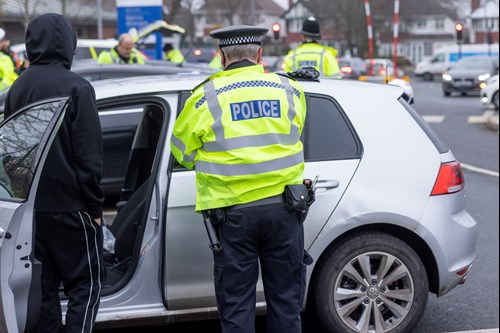
Seeking support for the change in the law, Tim explained: “Granting officers a clear statutory power to direct a driver and/or occupants to leave a vehicle would close this gap. It would enable officers to secure the vehicle, reduce the threat posed by determined offenders and better protect the public, as well as themselves.
“Just as importantly, it would give officers the confidence to use stop powers consistently, instead of hesitating due to the risks of an unsecured vehicle. Speaking to a driver or occupant in a safe space outside the vehicle has the added advantage that an officer or stationary vehicle is not exposed to live traffic and the associated risks. This is especially true with the Managed Motorway route network where motorists do not always take advantage of the limited safe refuge stopping points.”
He concluded: “Roads policing is one of the most effective enablers in tackling serious organised crime, violence against women and girls, county lines exploitation and terrorism. The evidence is clear: all serious criminals use the roads. Routine traffic stops have disrupted multi-million pound drug runs, removed dangerous weapons and intercepted individuals linked to organised crime networks.”
The Police Federation of England and Wales has developed draft legislative wording which could be incorporated into the forthcoming Road Safety Bill. This is a timely and proportionate reform that would save lives, protect officers and strengthen public safety, without imposing any burden on law-abiding motorists.