

Chair attends productive Westminster briefing with Welsh MPs
6 March 2026
Gwent Police Federation chair Matthew Candy met with MPs from across Wales in Westminster to discuss some of the issues facing policing.
Matthew described the event at Portcullis House near the Houses of Parliament as ‘really productive’.
He joined regional and national Federation colleagues for an event to brief Welsh MPs about police-related legislation going through Parliament.
The Police Federation of England and Wales (PFEW) is working with peers on several amendments to the Crime and Policing Bill on issues which impact on the health, wellbeing, and safety of police officers.
Suicides
Those amendments, tabled by Lord Bailey of Paddington, are:
-
The need to record officially the number of police officer suicides and attempted suicides
-
A time limit set for police misconduct investigations
-
The requirement for people to leave vehicles when stopped by police, for safety reasons
The MPs briefing, held on Tuesday, aimed to highlight the amendments with Welsh MPs and seek their support when the Bill returns to the House of Commons.
Matthew said: “I think the arguments that we made were overwhelmingly well received because they are compelling and almost can't be argued against.”
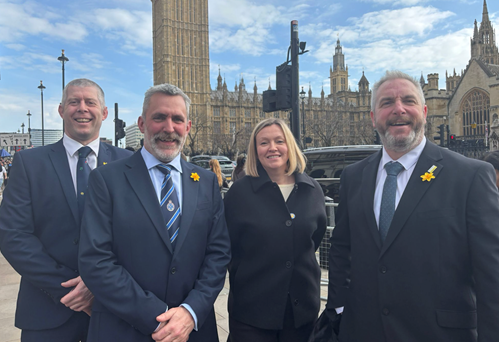
Matthew Candy (left) was joined in Westminster by representatives from
the four Welsh Federation regions
He was joined by colleagues from the three other Welsh Federation branches, Dyfed Powys chair Delme Rees, North Wales conduct and performance lead Liz Owen, and South Wales chair Phil Walker. They were also joined PFEW Welsh co-lead Leigh Godfrey and deputy national chair Brian Booth.
The briefing was attended by eight Welsh MPs Jess Morden, Chris Evans, Gerald Jones, Ann Davies, Ruth Jones, Liz Saville-Roberts, Chris Elmore, Tonia Antoniazzi, and staff of Alex Davies-Jones.
Matthew said: “The MPs who attended were brilliant. They were willing to listen to us and to discuss the points we were making. It was really productive.
“It’s an incredibly busy period in the world and domestically, so we’re grateful for them for taking the time to speak to us.”
Misconduct
A central focus of the discussions was the need to introduce mandatory recording of police suicides and attempted suicides, alongside clear time limits for misconduct investigations.
Research PFEW found that between 2022 and 2025, more than 100 police officers and staff are known to have died by suicide, including at least 75 serving officers. More than 200 attempted suicides were also identified during the same period.
Matthew said: “If we don’t know the scale of police suicides and the potential reasons behind it, then we can’t start to put things in place to properly deal with it and support police staff.”
PFEW has identified a strong correlation between suicide and officers who were subject to misconduct or criminal investigations.
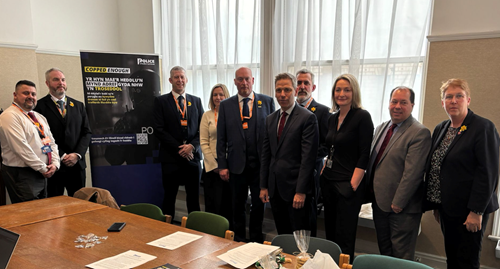
Matthew Candy (third left) joined colleagues and MPs to discuss policing issues
Matthew said: “We’ve had a case recently in Gwent where it’s taken since November 2022 to dismiss an officer in a hearing that lasted just six hours. “It can’t be right it’s taken that long.
There's not a person, be they civilian, serving officer irrelevant of rank, or MP, who wouldn't agree that you've got to speed up these processes.
“If you don't speed them up, it leads into the other issues of mental health and suicide, and they all come together.
“By speeding it up, you either get rid of them quickly or you bring them back to work quickly. But don't just leave someone at home for three or four years on full pay.
“It wouldn't happen in any other walk of life.”
MPs were also briefed on proposed amendments to section 163 of the Road Traffic Act 1988.
Statutory power
The change would provide officers with a clear statutory power to require occupants to exit and remain outside a vehicle once a lawful stop has been made, addressing safety concerns linked to modern keyless and electric vehicles.
Matthew said: “These are simple fixes, in our view. Recording suicides, a simple legislative change to a roads traffic issue, and time scales for conduct investigations.”
He is now seeking even greater engagement with elected representatives in Westminster and the Senedd, and hoping to involve the Police Superintendents’ Association and even chief constables ‘to help get the messages across’.
Matthew said: “We are trying to stay non-political, but the points we’re making are bipartisan and need to be heard.
“We are looking to work alongside the Police Superintendents’ Association and our Chief Constable to secure wider support and strengthen the impact of our messaging with MPs.”
READ MORE: Scale of violence against police laid bare in new covenant report.