

Men’s Health Month: ‘trauma impacts us and those around us’
28 November 2025
For Gwent Police Inspector Rob Witherall, policing isn’t just a job, it is a lifelong identity shaped by family, duty, and the unseen weight of trauma.
At 44, and now in his 22nd year of service, Rob has spent his entire career with Gwent Police.
In many ways, his journey began long before he ever put on the uniform, with his father serving as a police officer for three decades.
“Dad’s stories fascinated me,” said Rob, who admits he joined the Force because he wanted to give something back.
He joined in 2003 and was given his dad’s old collar number.
Collar number
“I followed in his footsteps,” he reflected. “The job isn’t what we do - it’s who we are.”
Policing, Rob explained, becomes ingrained not just in an officer’s routine but also in their emotional world. Daily exposure to trauma leaves a mark, even for the most experienced officers.
“It’s emotional baggage we carry with us. You can go from child deaths to road traffic collisions in a matter of hours. It’s no wonder you get affected,” he says.
He likened the emotional impact to a sponge: “If you keep adding and adding to the sponge, eventually that sponge gets full.”
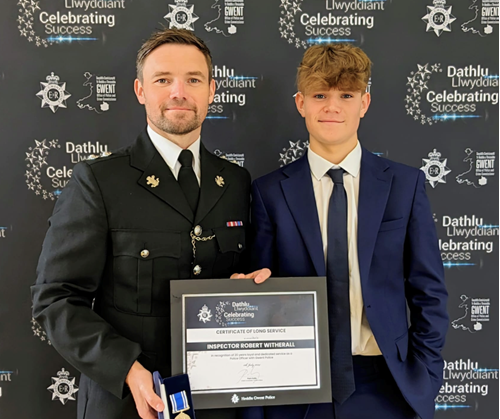
Rob and his son Noah.
Demand on frontline officers has only grown over the years, although each generation of policing has faced its own battles.
However, Rob recognised that today’s pressures are heavier, more complex, and more relentless.
Rob has attended hundreds of fatalities during his career. As a Family Liaison Officer, he has stood with families at their lowest moments, guiding them through grief that feels senseless and devastating.
“It can be totally exhausting,” he continued. “You’re supporting families whose lives have been destroyed. They can’t make sense of what’s happened - and we have to help them through that.”
Emotional
Over time, that emotional load began to take a toll.
“I didn’t think I should be struggling,” said Rob, who experienced flashbacks, sleeplessness, and overwhelming emotion.
“But one day I opened up to someone about the job, and they said, ‘no wonder you feel like this.’”
He underwent Cognitive Behavioural Therapy (CBT) and EMDR (Eye Movement Desensitisation and Reprocessing) to treat him for PTSD (Post-Traumatic Stress Disorder).
This helped him process years of trauma that he hadn’t realised he was carrying.
“It was very helpful to talk,” he added. “One of the biggest things is that there seems to be a shame in speaking - but actually, I think you’re stronger for talking.”
Retirement
Even his father, decades after retirement, still has dreams about past incidents. Trauma, Rob says, doesn’t disappear just because the job is done.
Rob now speaks openly about his mental health as a way to encourage others to do the same.
“We’re a small team, and we talk a lot. Being open has helped us,” he said.
He encourages officers to engage with TRIM (Trauma Risk Management) - even if they feel they are coping.
“You might feel fine at the time, but it might impact you in the future,” he warned.
Rob said his experience is a reminder that trauma does not simply stay at work - it follows officers home, affecting families, friends, and everyday life.
Trauma
He said: “You carry that trauma throughout your day. And it doesn’t just impact you - it impacts those around you. When you’re struggling, so do they.
“My message is simple: reach out to your friends and loved ones. You know them, you know when they need support.
“And when it’s offered, whether through TRIM, occupational health or simply via a conversation - accept help.
“Finally, talk. Even when it’s difficult, talk.”
Rob ended by saying that speaking up did not just help him understand his struggles, but it also allowed him to keep being the officer, father, colleague, and leader he strives to be.
READ MORE: The scale of officer suicides is being severely underestimated.